Crochet calculators help you plan a handmade project before you pick up your hook. Use these free tools to estimate the starting chain for an oval base, the number of granny squares for a blanket, or the skeins needed when you change yarn. Each answer gives you a starting point that you can check against your own measurements.
These crochet calculators are most useful when you enter numbers from a sample made with your chosen yarn, hook, and stitch. Start with the tool that matches your project, then measure your work as it grows.
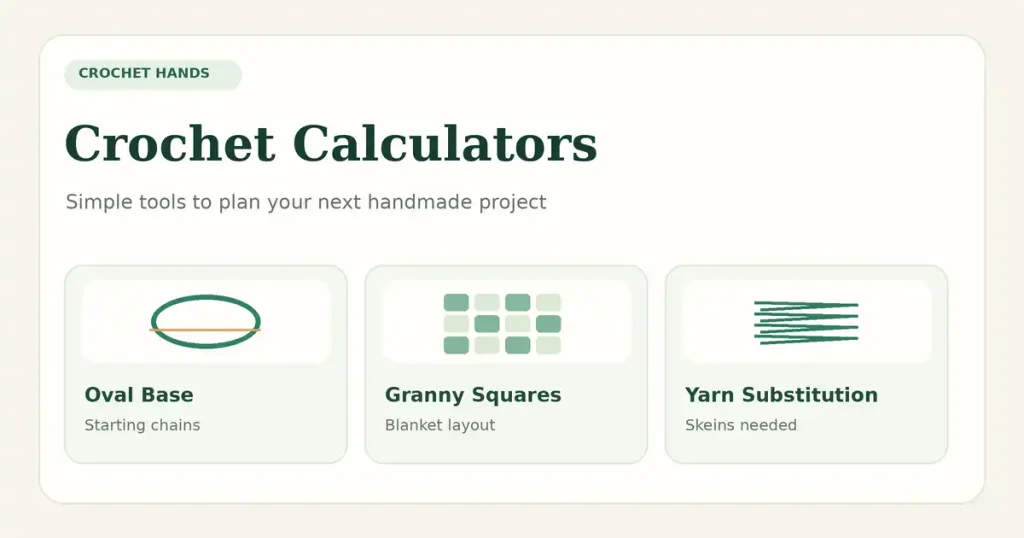
Free crochet tools
Plan your next crochet project
Choose a calculator below. Results are instant and no signup is required.
Crochet Oval Base Calculator
Estimate the foundation chain for an oval worked around both sides of a starting chain.
Use the same measurement unit for the finished dimensions and swatch.
Measure the oval as you work. Stitch height, increases, and tension affect the final size.
Granny Square Blanket Calculator
Calculate how many finished granny squares you need for a blanket.
Use one unit throughout and include the join in the finished square size.
Yarn Substitution Calculator
Find how many skeins of a replacement yarn cover the length required by a pattern.
Compare yarn weight and fibre, then make a gauge swatch.
Crochet Gauge Calculator
Convert any measured swatch into stitches and rows per 10 cm and per 4 inches.
Measure the centre of a washed and blocked swatch.
Foundation Chain Calculator
Estimate a starting chain for a target width, pattern repeat, and turning chains.
Make a short sample when the finished width must be exact.
Flat Crochet Circle Calculator
Estimate rounds and stitch counts using common flat-circle increase rules.
If the circle cups, add increases. If it ruffles, use fewer.
Crochet Hook Size Converter
Convert common metric crochet hook sizes to US labels and typical yarn uses.
The metric diameter is the most reliable comparison between manufacturers.
Crochet Blanket Planner
Estimate starting stitches, rows, and optional yarn weight from a gauge swatch.
Add turning chains and extra yarn for borders separately.
Crochet Calculators for Oval Bases
An oval base can form the bottom of a crochet bag, basket, or pouch. Its straight middle section begins with a foundation chain; stitches worked around both sides create the rounded ends. The oval tool estimates a starting chain from the finished length and width you want.
Enter your target length and width in the same unit. Next, enter how many stitches you counted across a swatch and the measured width of that swatch. For example, if your swatch has 16 stitches across 10 cm, enter 16 and 10. If your target oval is 25 cm long and 12 cm wide, the calculator suggests approximately 22 starting chains.
That answer is an estimate, not a complete oval pattern. Stitch height and increases at the ends affect the finished shape. After a few rounds, lay the base flat and measure both directions. Adjust the following rounds if it is growing wider or longer than planned. Crochet calculators can save you from guessing the first chain, while measuring the actual fabric helps you finish at the size you need.
Plan a Granny Square Blanket
The granny square tool tells you how many finished squares fit across and down your planned blanket. Enter the blanket width, blanket length, and the size of one completed square. Use centimeters throughout or inches throughout.
Measure a finished square after blocking if you intend to block the whole blanket. Think about the joining method too: a wide join may add space between squares. Enter a square size that reflects the way the squares will look once joined.
For a blanket of at least 100 × 120 cm using 10 cm finished squares, the layout is 10 squares across and 12 down, or 120 squares altogether. If you enter the grams of yarn used for one square, the tool also estimates yarn for the squares. Set aside additional yarn for joins and borders.
These crochet calculators show whole-square layouts, so the suggested finished blanket can be slightly larger than your target. If you want to try making a square before planning the full blanket, start with our Easy Crochet Granny Square Pattern.
Estimate Yarn for a Substitute
A replacement yarn may have a different number of meters or yards in each skein. The yarn substitution tool starts with the total length required by your pattern and divides it by the length in one skein of your chosen yarn. It rounds up because you cannot normally buy part of a skein.
Enter both lengths in meters or both in yards. You can add an extra percentage for a little more yarn. If a pattern requires 900 meters and the substitute contains 210 meters per skein, a 10% allowance produces a target of 990 meters. The tool recommends five skeins.
Yarn length does not tell you whether the replacement will create the same fabric. Compare its thickness and make a swatch before committing to a fitted project. Lion Brand’s yarn substitution guidance explains why matching and checking gauge matters. Use crochet calculators to estimate what to buy, then use your swatch to check how the new yarn behaves.
Measure a Swatch First
A swatch is a small piece made with the yarn, hook, and stitch you plan to use. Count the stitches across a measured width without stretching the fabric. If you change your hook or yarn, make another swatch before relying on the old measurement.
The Craft Yarn Council’s guide to gauge explains how stitches and rows affect project size. For the oval tool, the stitch count helps estimate your chain. For a blanket, a completed square gives you a more realistic layout and yarn estimate.
Crochet calculators work best as planning aids. Keep checking your project during construction, especially when changing stitch patterns, adding a border, or working with yarn that differs from the pattern.
Frequently Asked Questions
Are these results exact?
No. The tools estimate quantities from the numbers you provide. Individual tension, stitches, joins, and finishing choices can change the result. Measure your work and adjust as you crochet.
Can I use inches instead of centimeters?
Yes. Use one unit consistently within the oval or granny square tool. For yarn substitution, enter both yarn lengths in yards or both in meters.
Will the yarn tool tell me whether two yarns have the same gauge?
No. It estimates how many skeins cover the length you enter. Make a swatch to check the replacement yarn’s gauge and the fabric it creates.
Start Your Next Project
Try the crochet calculators before beginning a larger make, then save your measurements for the next one. If you want a small project to practice careful counting and shaping, explore our Crochet Strawberry Pattern.