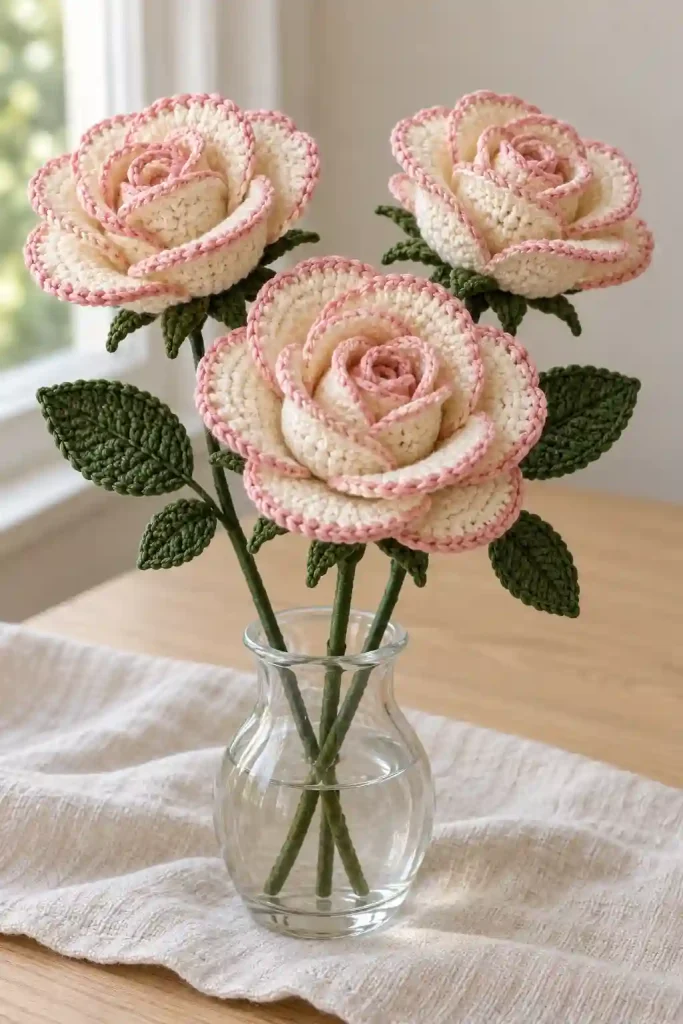
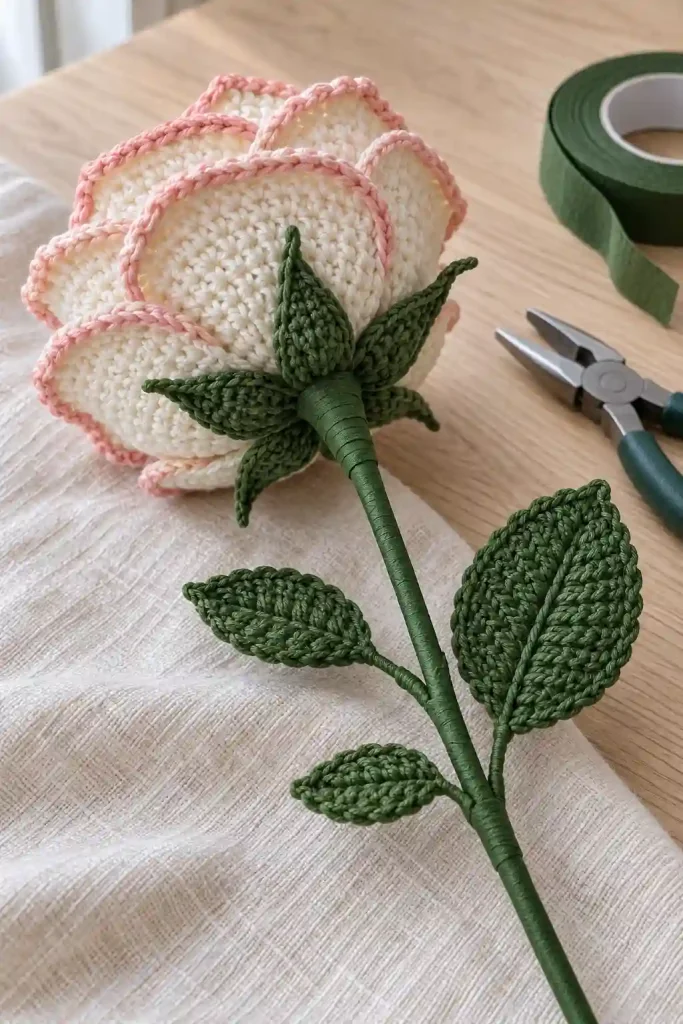
Crochet Rose Bouquet Pattern projects create lasting flowers for a vase, a handmade gift, or a special table display. This version combines ivory petals with pink borders, green calyxes, and wired leaves. You will learn how to make three petal sizes, layer each blossom, and secure the stems. The supplied tutorial summary leaves several rounds unspecified, so this article provides a simplified, independently drafted adaptation with untested measurements and yarn estimates.
Crochet Rose Bouquet Pattern at a Glance
This project suits confident beginners ready to combine basic crochet with careful sewing and floral assembly. Most pieces use single crochet, while graduated stitch heights shape the calyx points and leaves.
The Crochet Rose Bouquet Pattern makes three roses. Each flower contains three small petals, three medium petals, three large petals, one six-point calyx, two small leaves, and one larger leaf.
For the full bouquet, make twenty-seven petals, three calyxes, and nine leaves.
Use sport-weight cotton and a 2.5 mm hook. Expect blooms approximately 2½–3 inches across and finished stems around 10–12 inches long. These are untested estimates.
Gauge is less critical than consistent fabric and matching petal sizes. Make and assemble one rose before completing the others. Allow several crafting sessions; a reliable making time has not been established. The wired construction is intended for decorative display.
Crochet Rose Bouquet Pattern: Materials and yarn quantities
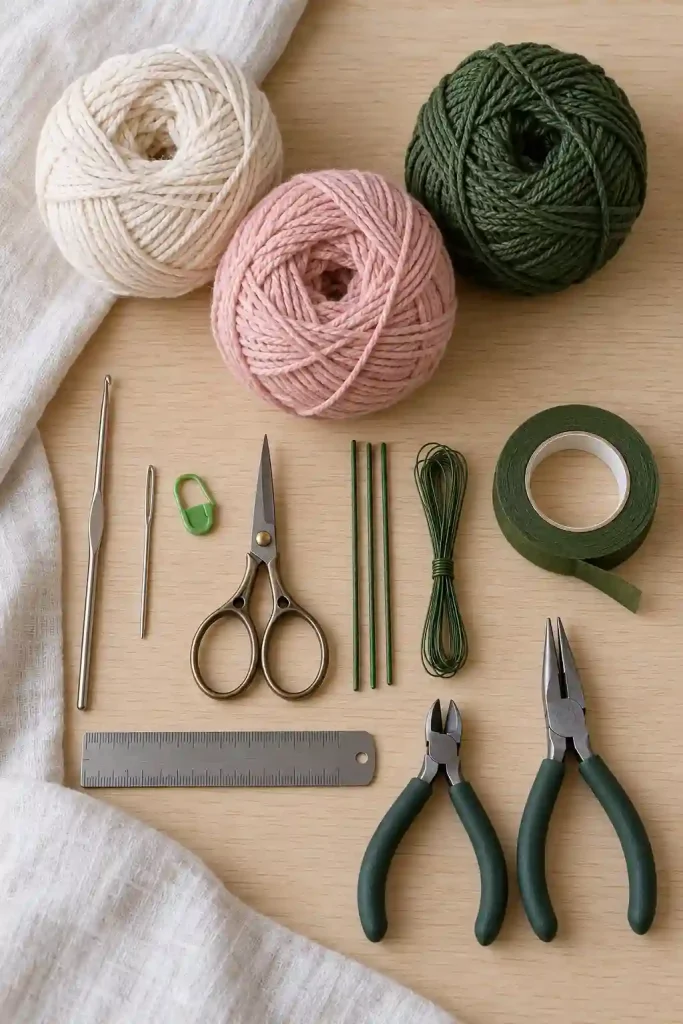
Gather these supplies for three roses:
- Ivory sport-weight cotton: Approximately 150–200 yards.
- Pink sport-weight cotton: Approximately 50–75 yards.
- Green sport-weight cotton: Approximately 75–100 yards.
- 2.5 mm crochet hook.
- Blunt yarn needle and scissors.
- Removable stitch marker.
- Ruler or measuring tape.
- Three florist stem wires: Approximately 12 inches long, firm enough to support your sample bloom.
- Thin, bendable floral wire: Nine pieces approximately 6 inches long for leaves.
- Green floral tape.
- Wire cutters and small pliers.
These quantities are generous, untested allowances for the Crochet Rose Bouquet Pattern. Actual consumption depends on yarn thickness, tension, and sewing tails. Grams are omitted because yardage per gram varies.
Choose smooth yarns of similar thickness. Cotton gives clear stitches, while a cotton-acrylic blend may produce softer petals.
Keep wire ends folded inward and concealed. Use wire cutters rather than yarn scissors for metal. No stuffing, glue, or separate flower center is required.
Crochet Rose Bouquet Pattern: Abbreviations and special stitches
The Crochet Rose Bouquet Pattern uses US terminology:
- ch: Chain.
- sc: Single crochet.
- hdc: Half double crochet.
- dc: Double crochet.
- tr: Treble crochet.
- sl st: Slip stitch.
- st/sts: Stitch/stitches.
- inc: Work 2 sc into one stitch.
A magic ring is an adjustable loop used to begin circular pieces.
For a treble crochet, yarn over twice, insert the hook, and draw up a loop. Yarn over and draw through two loops three times.
Repeat instructions in parentheses the stated number of times. Square brackets show stitch totals.
To change color, complete the final pull-through of the preceding stitch with the new yarn. Starting chains and joining slip stitches do not count.
Crochet Rose Bouquet Pattern Gauge, Size and Notes
The Crochet Rose Bouquet Pattern has no fixed gauge requirement. Aim for even fabric that bends into overlapping petals without large gaps.
Approximate finished sizes are:
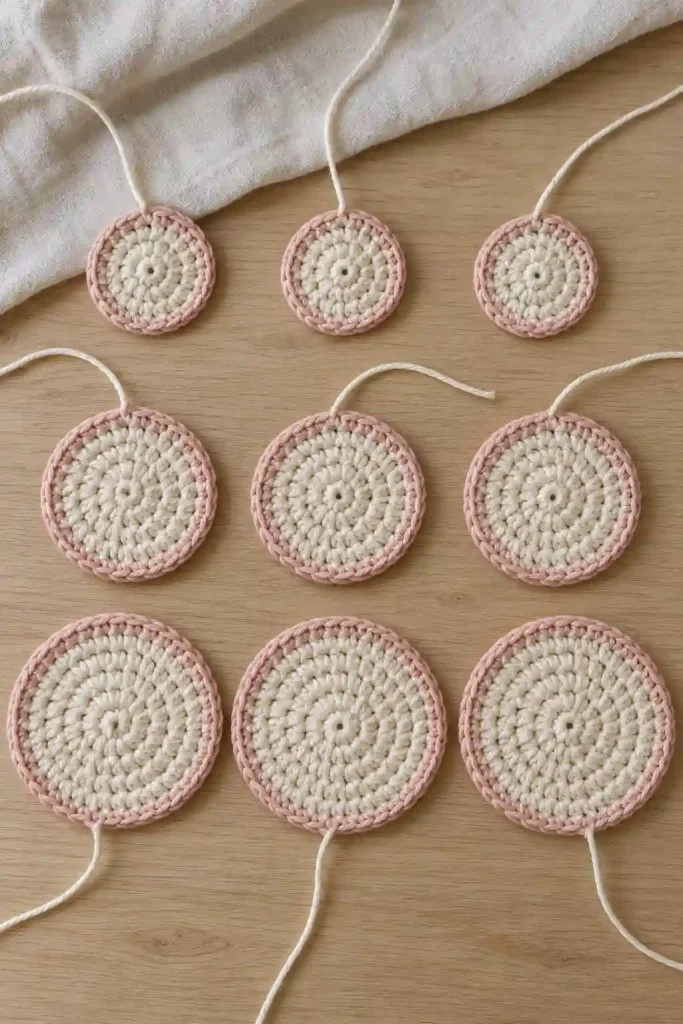
- Small petals: 1–1¼ inches across.
- Medium petals: 1¼–1½ inches across.
- Large petals: 1½–1¾ inches across.
- Assembled flowers: 2½–3 inches across.
- Finished stems: About 10–12 inches long.
These dimensions are untested. Measure petals relaxed before assembly and flowers across their widest opening.
Petal bodies use continuous rounds. Move the marker after every round without joining or turning. Their pink borders use joined rounds.
The calyx has a continuous-round center followed by six points. Leaves are worked around both sides of a foundation chain.
A little petal cupping is intentional. Compare matching pieces before sewing, and use the same hook and tension throughout each group.
Crochet Rose Bouquet Pattern: Method overview
Begin the Crochet Rose Bouquet Pattern by making one complete set of nine petals. All sizes start with the same three rounds, then receive different amounts of widening and depth.
Add one pink border round to every petal. Preserve an ivory sewing tail for assembling the lower portions without visible pink stitches across the flower.
Next, make a green calyx with six pointed sepals. Crochet two small leaves and one larger leaf, then sew thin wire along their backs.
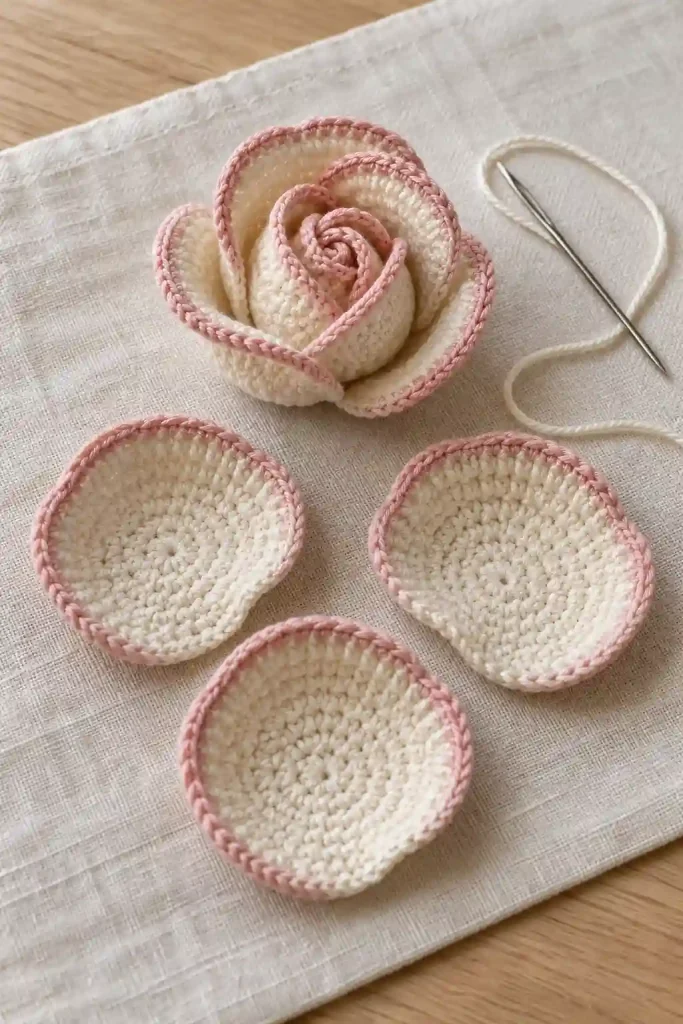
Roll the small petals into a central bud. Overlap the medium petals around that center, followed by the large outer petals.
Secure the flower to a looped stem wire, sew the calyx beneath it, and attach the leaves with floral tape.
Finish one stem before repeating the process twice. This lets you assess the bloom’s weight and adjust your assembly technique before making the full bouquet.
Crochet Rose Bouquet Pattern: Step-by-Step Tutorial
Make the Small, Medium, and Large Petals
For each rose in the Crochet Rose Bouquet Pattern, make three petals of each size.
Shared ivory rounds:
- Round 1: Work 6 sc into a magic ring. [6]
- Round 2: Inc in every stitch. [12]
- Round 3: (Sc, inc) six times. [18]
Small petals:
- Round 4: Sc around. [18]
- Round 5: With pink, sc around. [18]
Medium petals:
- Round 4: (Sc in the next 2 sts, inc) six times. [24]
- Round 5: Sc around. [24]
- Round 6: With pink, sc around. [24]
Large petals:
- Round 4: (Sc in the next 2 sts, inc) six times. [24]
- Round 5: (Sc in the next 3 sts, inc) six times. [30]
- Round 6: Sc around. [30]
- Round 7: With pink, sc around. [30]
Change color on the final pull-through of the last ivory stitch. Cut ivory, leaving a 12-inch sewing tail.
After the pink round, sl st into its first sc and fasten off. Secure the pink ends. Repeat for nine petals per flower.
Crochet the Six-Point Green Calyx
Make one calyx per flower in the Crochet Rose Bouquet Pattern.
Using green yarn:
- Round 1: Work 6 sc into a magic ring. [6]
- Round 2: Inc in every stitch. [12]
- Round 3: (Sc, inc) six times. [18]
- Sl st into the first stitch of Round 3.
Now make the six points:
- Ch 7.
- Starting in the second ch from the hook, work sl st, sc, hdc, dc, tr, tr across the six available chains.
- On the circular base, skip the next 2 sts and sl st into the following stitch.
- Repeat Steps 1–3 five more times.
Each point contains six return stitches. Each anchoring step advances three base stitches, so six points travel around all eighteen stitches.
The final anchor returns to the stitch where the first point began. Do not add another point there.
Fasten off with a 16-inch sewing tail. Secure the magic-ring tail and arrange the six points evenly. Keep the long finishing tail available for sewing the calyx beneath the bloom.
Make and Wire the Two Leaf Sizes
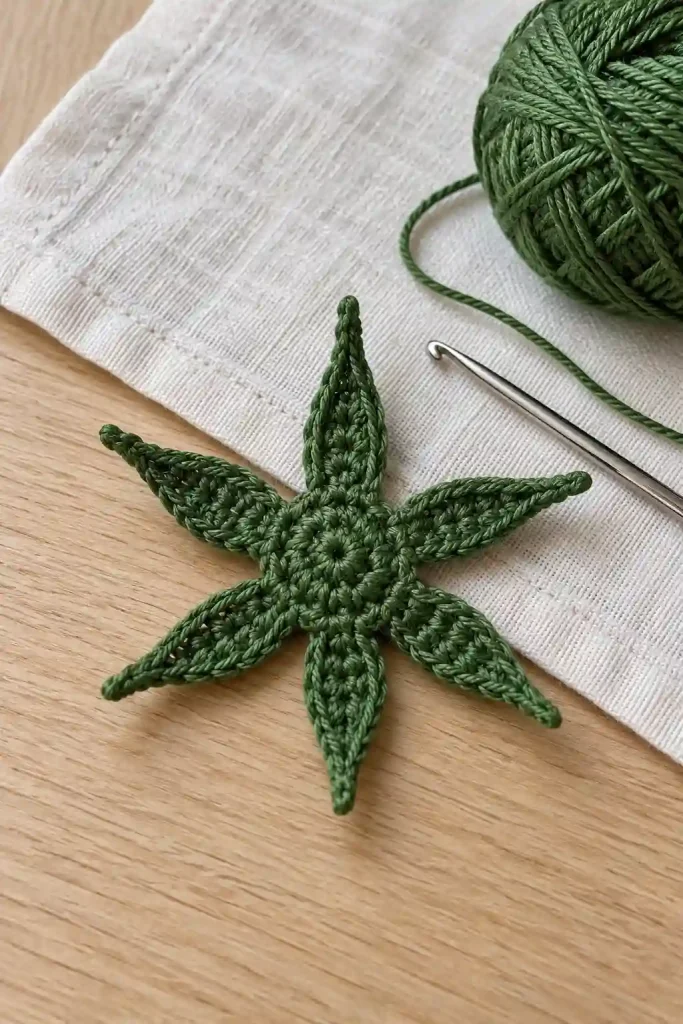
Each stem in the Crochet Rose Bouquet Pattern needs two small leaves and one large leaf.
Small leaf:
- Ch 8.
- Starting in the second ch from the hook, work sc, hdc, dc, dc, hdc, sc into the next six chains.
- Work 3 sc into the final chain.
- Continue along the opposite side: sc, hdc, dc, dc, hdc, sc. [15]
- Sl st into the first sc and fasten off.
Large leaf:
- Ch 10.
- Starting in the second ch from the hook, work sc, hdc, dc, tr, tr, dc, hdc, sc into the next eight chains.
- Work 3 sc into the final chain.
- Along the opposite side, work sc, hdc, dc, tr, tr, dc, hdc, sc. [19]
- Sl st into the first sc and fasten off.
Leave 12-inch green tails. These leaves have no additional edging round.
Fold one wire end into a small rounded loop. Lay it along the leaf’s back center, with the loop below the tip and the remaining wire extending from the base. Sew over the wire at several points without piercing it.
Crochet Rose Bouquet Pattern: Assembly
Use pliers to bend the top of a stem wire into a small closed loop.
Roll one small petal into a loose cone and sew its lower third. Overlap the other two small petals around it. Place the wire loop against the bud’s underside and stitch around it repeatedly, catching several petal layers.
Add three medium petals, overlapping their edges around the center. Sew their lower thirds to the existing base. Repeat with the three large petals, offsetting them from the medium layer.
Position the calyx underneath, placing its center against the wire attachment. Sew through the calyx center and lower petal layers. Let its six points rise around the flower’s base.
Wrap floral tape beneath the calyx and down the stem. Add the three leaf wires at staggered heights, trapping their tails beneath overlapping tape. Fold and cover the lower stem end.
Repeat for three roses. Floral tape covers the construction; the sewing provides the flower’s main attachment.
Crochet Rose Bouquet Pattern: Finishing and care
Weave remaining yarn ends through several stitches, changing direction before trimming. Keep structural sewing tails secure inside the petal base.
Shape petals with your fingers. Open the outer layer gently while keeping the center compact. Avoid pulling the pink borders into exaggerated ruffles.
If blocking is necessary, follow the yarn label and block separate crochet pieces before attaching wire and tape. Avoid applying direct heat to assembled flowers.
Dust the bouquet with a soft brush. Spot clean suitable yarn carefully, keeping moisture away from floral tape and metal components. Do not assume the assembled arrangement is washable simply because the yarn is.
Inspect every wire end and attachment. Place the bouquet in a stable vase and keep the wired decoration away from young children and pets.
FAQs and Troubleshooting for Crochet Rose Bouquet Pattern
1. Why does my large petal have twenty-nine stitches instead of thirty?
Round 5 needs six increases distributed across twenty-four stitches. Each repeat uses four existing stitches and produces five. A missed increase leaves twenty-nine. Return to the start of that round and work six complete repeats of three ordinary single crochets followed by one increase.
2. Why are my petals too curled or my flower too flat?
The plain rounds intentionally create shallow cupping. Strong curling can come from tight tension or an overly tight pink border. A flat-looking flower may need more overlap during assembly. Check stitch counts first, then adjust the placement and sewing of the lower petal thirds before changing the crochet instructions.
3. Can I substitute DK yarn or acrylic?
Yes, but make one complete flower first. DK usually produces larger, heavier petals, while acrylic may behave differently when shaped. Choose a suitable hook and reassess the stem support. Keep ivory and pink yarn close in thickness so the border does not noticeably tighten or stretch the petal edge.
4. How can I make a bigger bouquet?
Repeat the complete nine-petal flower unit, including its calyx, leaves, and stem. Calculate supplies from the yarn used for your first finished rose rather than multiplying these untested estimates blindly. Arrange additional stems at different heights and use a vase wide enough to support the expanded group.
5. Can I wash the finished wired roses?
The yarn, floral tape, and wire all affect cleaning. Immersion may loosen tape or damage metal even when the yarn itself is washable. Dusting and careful spot cleaning are more practical starting points. If a flower becomes wet, support its shape and let every component dry completely before display.
Final Thoughts
The Crochet Rose Bouquet Pattern combines repeated crochet pieces with thoughtful assembly. Make one rose first, compare its petal sizes, and check that the stem supports the finished bloom. This adaptation is untested, so record the yarn, hook, and assembly choices that work for your sample before completing the other stems. For more floral inspiration, explore Hookok’s crochet rose patterns. If you prefer a smaller handmade gift, try the crochet heart bookmark pattern. With secure joins and gentle shaping, your three-flower arrangement can become a personal display in your chosen colors.