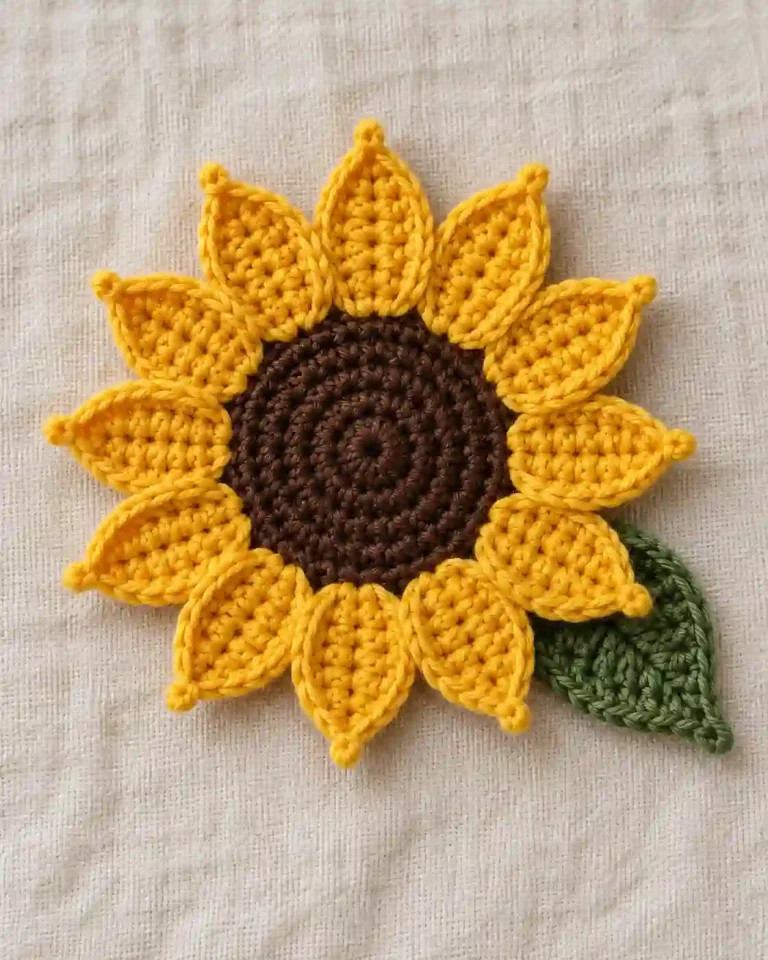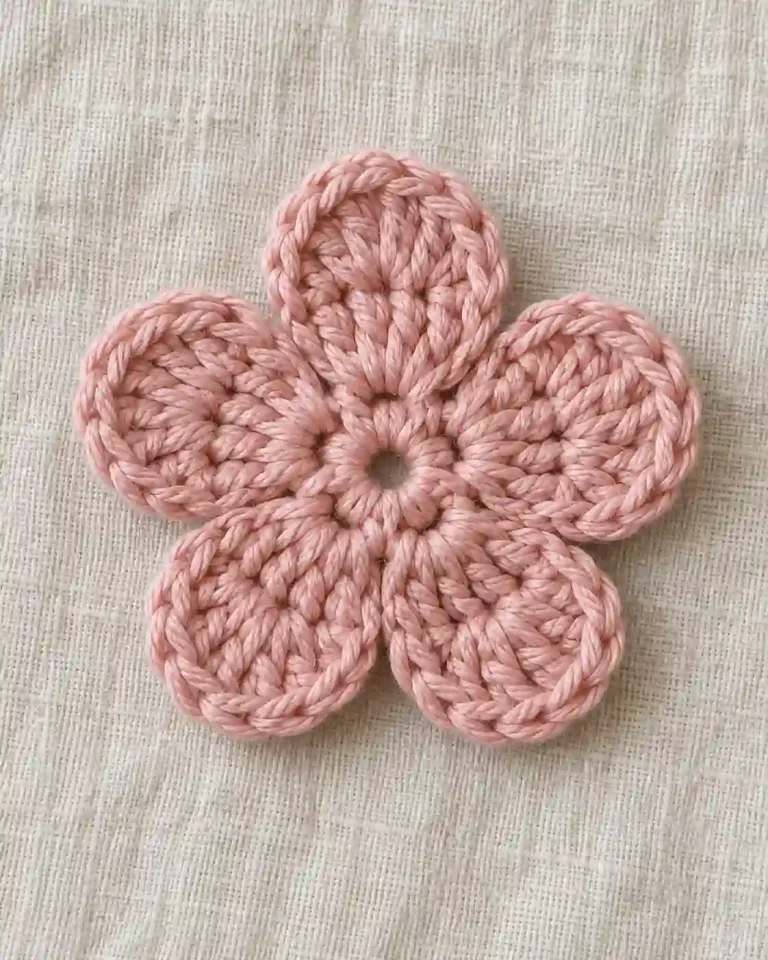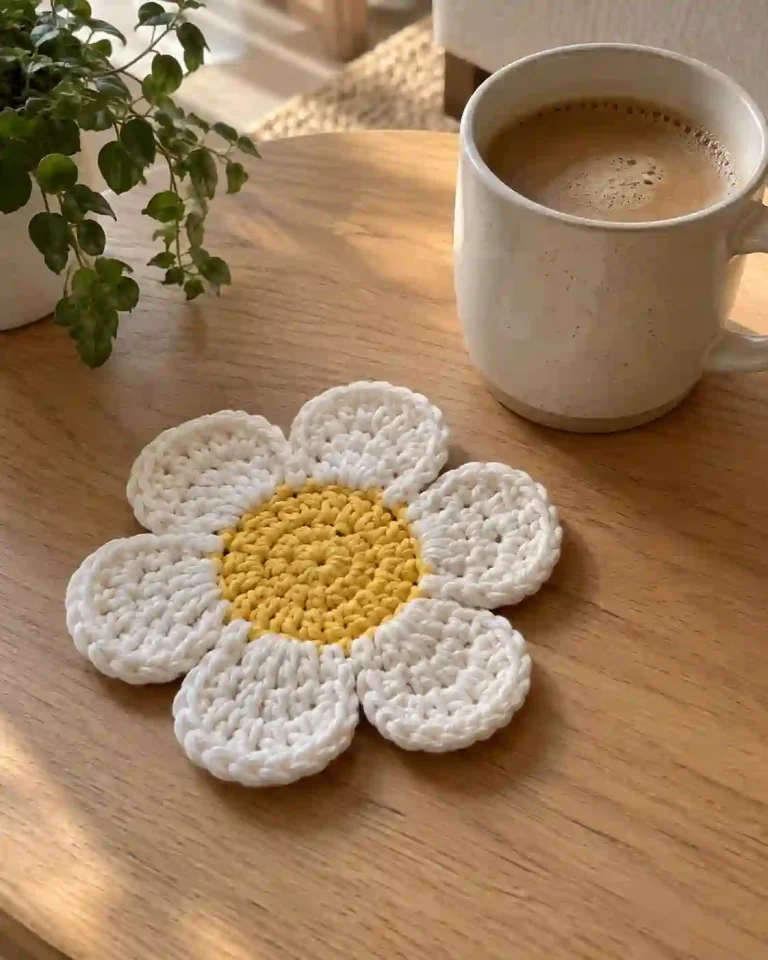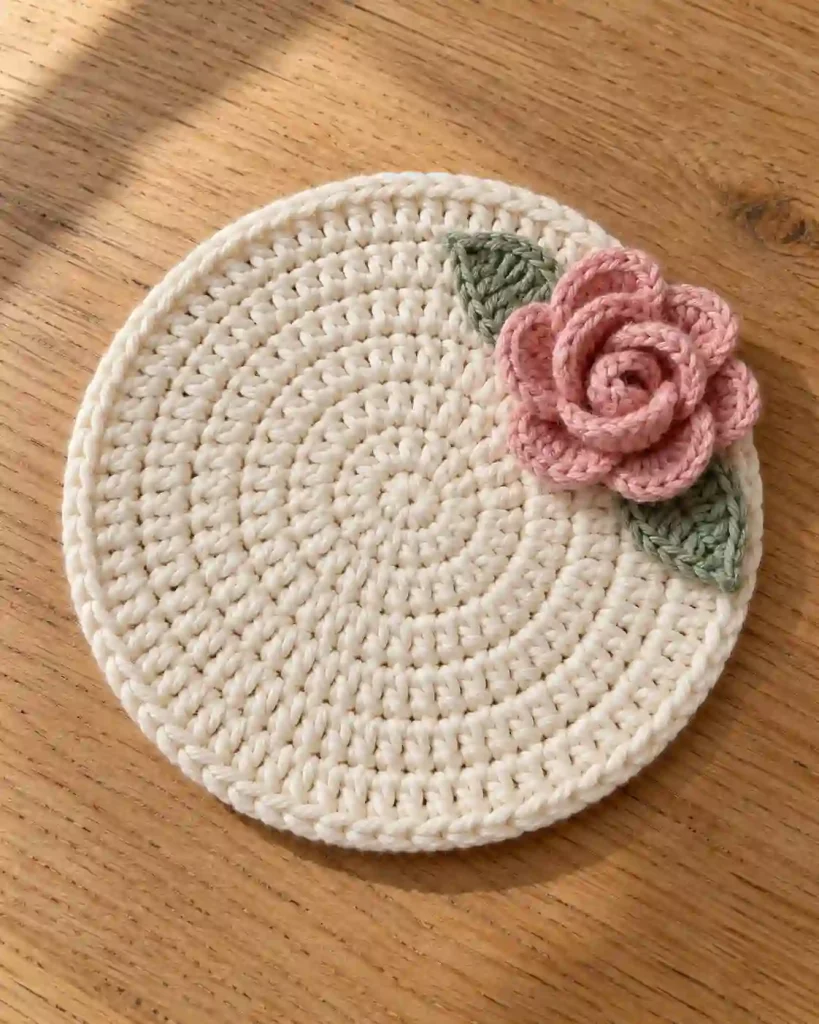
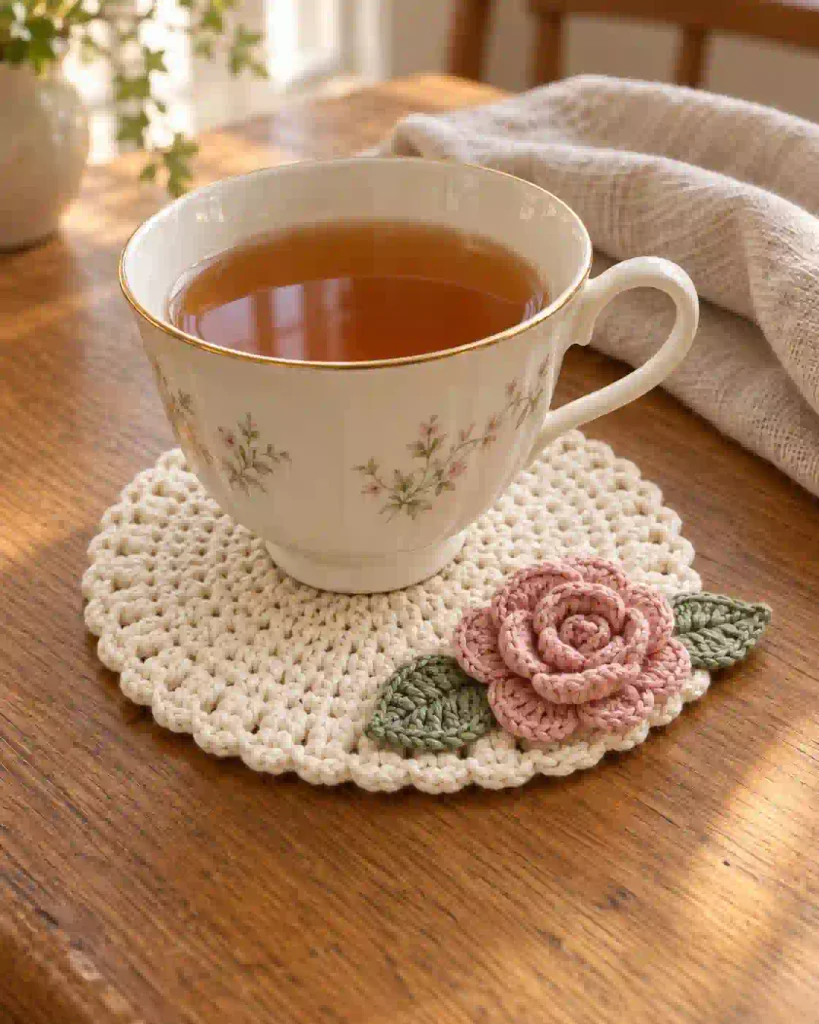
This Crochet Rose Coaster Pattern combines a practical round coaster with a beautiful three-dimensional rose and two small green leaves. The flat base provides a stable surface for your teacup, while the raised flower adds a charming decorative touch along the edge. In this free, beginner-friendly tutorial, you’ll learn how to crochet the coaster base, create layered rose petals, shape the leaves, and assemble your finished project. If you enjoy floral crochet projects, explore our Crochet Flower Coaster Pattern for another lovely handmade design.
Crochet Rose Coaster Pattern at a Glance
This Crochet Rose Coaster Pattern is designed for crocheters who know basic stitches and want to try a simple floral embellishment.
Unlike a coaster covered entirely with raised petals, this design keeps the main surface flat. The rose is positioned near the outer edge, creating a decorative accent while leaving room for a cup.
The project consists of a round coaster base, a rolled rose, and two separate leaves.
The Crochet Rose Coaster Pattern is ideal for anyone who enjoys combining simple crochet techniques with elegant floral home decor.
Project details:
- Skill level: Confident beginner
- Yarn: DK-weight (#3) cotton
- Hook size: 3.5 mm (US E/4)
- Estimated coaster diameter: 4–4.5 inches (10–11.5 cm)
- Estimated rose diameter: 1.5–2 inches (3.8–5 cm)
- Estimated making time: 60–90 minutes
- Construction: Five joined rounds for the base, one two-row rose strip, and two leaves
- Gauge: Not critical, but a flat base is important
- Terminology: US crochet terms
All dimensions, quantities, and time estimates are approximate. This original pattern has not been physically tested.
Because the rose is raised, use the coaster only when your cup can sit securely on the uncovered central area.
Crochet Rose Coaster Pattern: Materials and Yarn Quantities
Choose cotton yarn for this Crochet Rose Coaster Pattern if you want a coaster that has clear stitch definition and a reasonably firm surface.
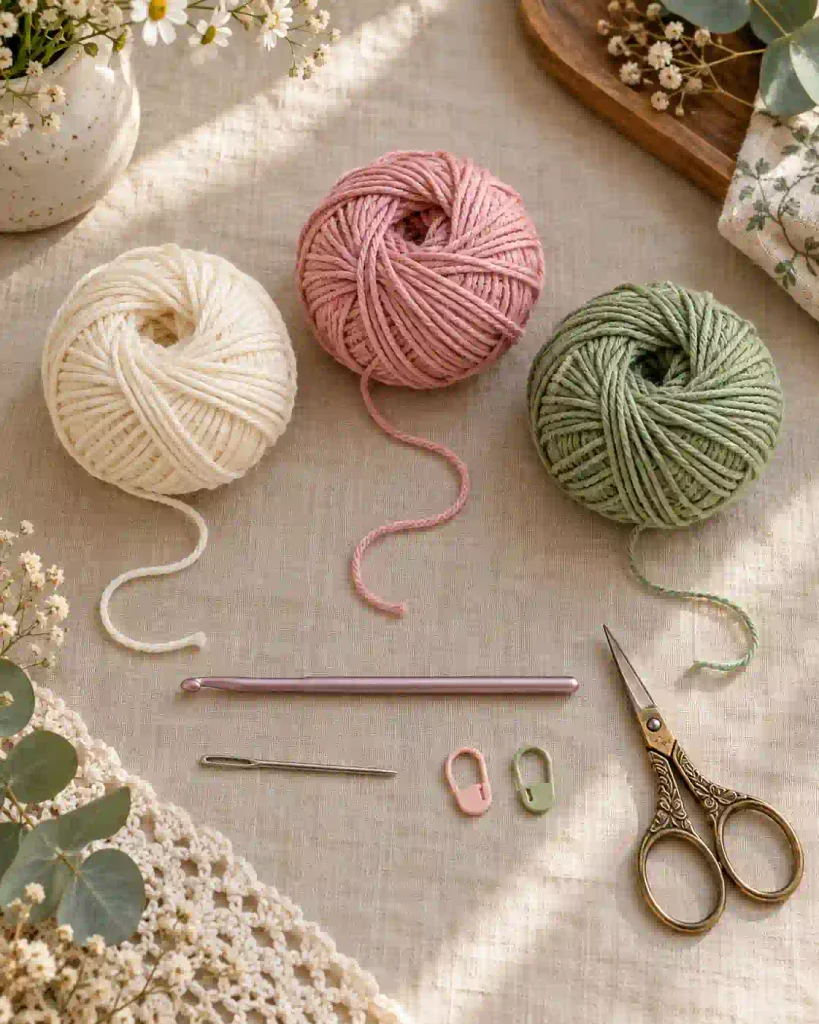
Materials
- Base color: Approximately 20–30 yards (18–27 m) of DK-weight (#3) cotton yarn
- Rose color: Approximately 10–15 yards (9–14 m) of DK-weight cotton yarn in pink, red, or another floral shade
- Leaf color: Approximately 4–6 yards (3.7–5.5 m) of DK-weight green cotton yarn
- Crochet hook: 3.5 mm (US E/4)
- Yarn needle: For assembly and weaving in ends
- Scissors: For trimming yarn
- Optional stitch marker: To identify the first stitch of each round
- Optional rustproof pins and blocking mat: For shaping
These quantities are estimates rather than measurements from a tested sample.
Milk cotton yarn may also be suitable if its thickness and fiber content work for your intended use. Check the label, since yarns sold under that name can differ.
Cotton is generally a more practical choice than highly fuzzy or stretchy yarn for a coaster.
For guidance on selecting equivalent yarn thicknesses, consult the Craft Yarn Council’s standard yarn weight system.
Avoid using highly textured yarn for your first attempt because it can make stitch counting difficult.
For this Crochet Rose Coaster Pattern, choosing smooth cotton yarn makes the stitches easier to see and helps the coaster maintain its shape.
Crochet Rose Coaster Pattern: Abbreviations and Special Stitches
This pattern uses US crochet terminology.
| Abbreviation | Meaning |
|---|---|
| ch | Chain |
| sc | Single crochet |
| hdc | Half double crochet |
| dc | Double crochet |
| sl st | Slip stitch |
| st | Stitch |
| sp | Space |
| rep | Repeat |
Magic ring: An adjustable loop used to begin the coaster in the round.
Increase: Work two stitches of the indicated type into the same stitch.
Petal shell: Five double crochet stitches worked into one stitch.
Repeat notation: Repeat the instructions inside parentheses the stated number of times.
The beginning chain 2 in coaster rounds does not count as a stitch. Joining slip stitches are also excluded from stitch counts.
For additional guidance on stitch names, see the Craft Yarn Council’s crochet abbreviations guide.
Crochet Rose Coaster Pattern Gauge, Size and Notes
With DK-weight cotton yarn and a 3.5 mm hook, the coaster base is estimated to measure approximately 4–4.5 inches (10–11.5 cm) across.
The completed rose is expected to measure approximately 1.5–2 inches (3.8–5 cm) across, depending on how tightly it is rolled.
These measurements have not been confirmed by making a physical sample.
Gauge is less critical than maintaining a flat, stable coaster surface.
Measure the base across its widest point after Round 5. If it is smaller than expected, you may need a slightly larger hook or thicker yarn.
Important notes:
- Work the coaster base in joined rounds without turning.
- The coaster increases by 12 stitches in each round.
- The final base round contains 60 hdc.
- Work the rose strip in turned rows.
- Each leaf is crocheted separately around a foundation chain.
- Sew the rose and leaves near the coaster edge, leaving the center uncovered.
The finished size of this Crochet Rose Coaster Pattern depends on your yarn, hook, and tension.
Crochet Rose Coaster Pattern: Method Overview
This Crochet Rose Coaster Pattern uses three separate elements that are joined after crocheting.
First, make a circular base using half double crochet stitches. Five increasing rounds create a flat surface with sixty stitches around its outer edge.
Second, crochet the rose. Instead of making individual petals, create a long strip with a row of shell stitches. Roll the strip into a spiral to form the flower’s layered appearance.
Third, crochet two small green leaves. These are made around short foundation chains and positioned beneath the rose.
After completing the pieces, sew the rolled rose together at its base. Attach the leaves to the underside of the flower, then secure the arrangement near the coaster’s outer edge.
This construction keeps the decorative elements together and makes their placement easier to adjust.
Before permanently attaching the flower, place your intended cup on the base to check the available flat area.
Step-by-Step Crochet Rose Coaster Pattern
Step 1: Crochet the Flat Round Coaster Base
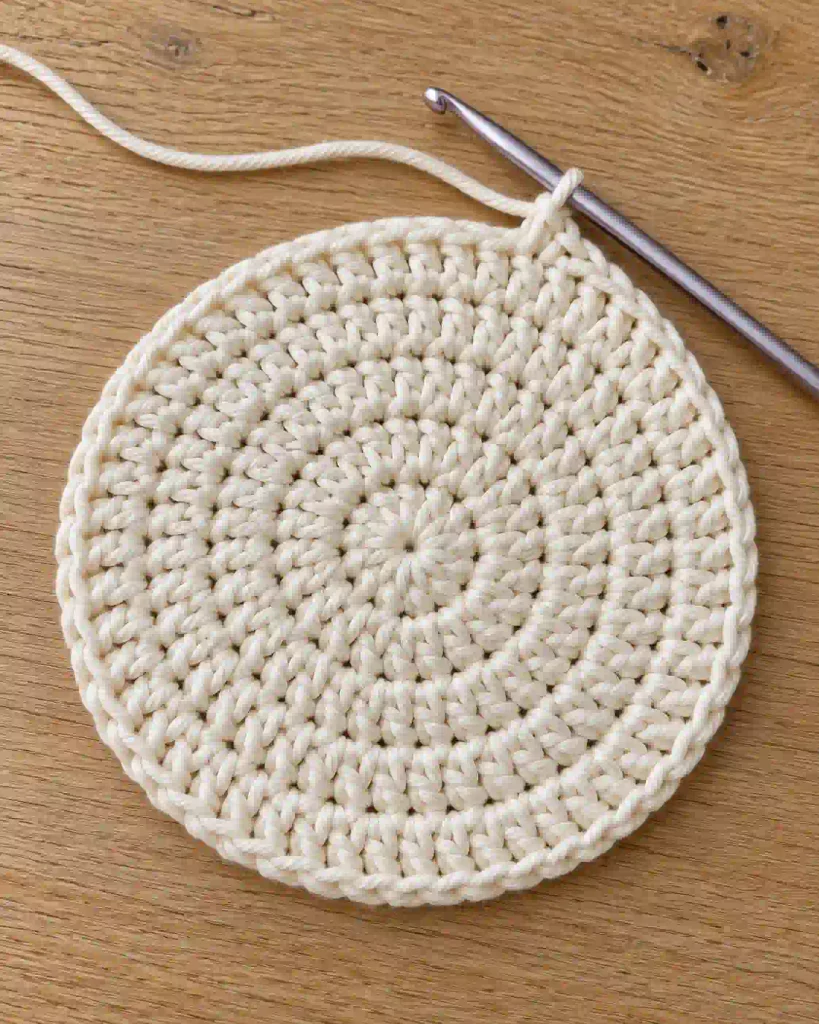
Use your chosen base-color DK-weight cotton yarn and a 3.5 mm hook.
Round 1
- Make a magic ring.
- Chain 2. This does not count as a stitch.
- Work 12 hdc into the ring.
- Pull the ring closed.
- Join with a sl st to the first hdc.
Stitch count: 12 hdc.
Round 2
- Chain 2.
- Work 2 hdc into each stitch around.
- Join with a sl st to the first hdc.
Stitch count: 24 hdc.
Round 3
- Chain 2.
- Repeat (1 hdc in the next stitch, 2 hdc in the following stitch) twelve times.
- Join to the first hdc.
Stitch count: 36 hdc.
Round 4
- Chain 2.
- Repeat (1 hdc in each of the next 2 stitches, 2 hdc in the next stitch) twelve times.
- Join to the first hdc.
Stitch count: 48 hdc.
Round 5
- Chain 2.
- Repeat (1 hdc in each of the next 3 stitches, 2 hdc in the next stitch) twelve times.
- Join to the first hdc.
Stitch count: 60 hdc.
Fasten off and weave in the ends.
The coaster should form a relatively flat circle. Check its shape before making the rose.
A flat, evenly crocheted base is essential for the Crochet Rose Coaster Pattern because it provides a stable surface for your cup.
Step 2: Crochet and Shape the 3D Rose
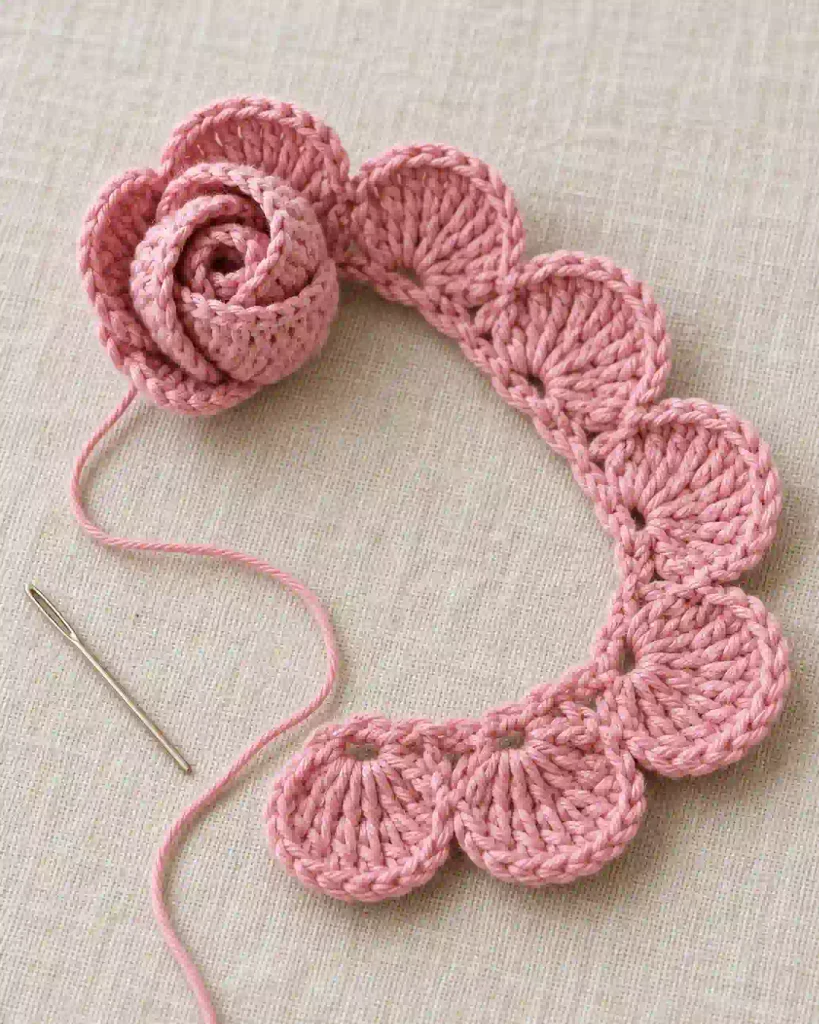
Use pink or red DK-weight cotton yarn.
The rose is made from a strip of connected petal shells.
Foundation
Chain 32.
Row 1
- Work 1 sc into the second chain from the hook.
- Work 1 sc into each remaining chain.
- Chain 1 and turn.
Stitch count: 31 sc.
Row 2 — Rose Petals
- Work 1 sc into the first stitch.
- Skip the next stitch.
- Work 5 dc into the following stitch.
- Skip the next stitch.
- Work 1 sc into the following stitch.
- Repeat Steps 2–5 seven more times.
- Fasten off, leaving a sewing tail approximately 12 inches (30 cm) long.
Petal count: 8 shells.
The completed strip contains eight rounded shell petals separated by single crochet stitches.
Each shell uses five double crochet stitches, creating forty double crochet stitches across the eight petals.
Shape the rose
Lay the strip with the petal shells facing upward.
Begin rolling from one short end, keeping the straight foundation edge aligned along the bottom.
Roll the first two petals fairly tightly to create the rose center.
Continue wrapping the remaining petals more loosely around the center to form the outer layers.
Hold the base together with your fingers while adjusting the petals.
Do not sew the rose onto the coaster yet. First secure the rolled layers during assembly.
The layered petals give this Crochet Rose Coaster Pattern its distinctive three-dimensional appearance without requiring individual petals to be sewn together.
Step 3: Crochet Two Small Green Leaves
Use green DK-weight cotton yarn and the same 3.5 mm hook.
Make two matching leaves.
Leaf — Make 2
- Chain 9.
- Work 1 sc into the second chain from the hook.
- Work 1 hdc into the next chain.
- Work 1 dc into each of the next 4 chains.
- Work 1 hdc into the next chain.
- Work 3 sc into the final chain.
- Rotate the work to crochet along the unused loops on the opposite side of the foundation chain.
- Work 1 hdc into the next chain.
- Work 1 dc into each of the next 4 chains.
- Work 1 hdc into the next chain.
- Work 1 sc into the final available chain.
- Join with a sl st to the first sc.
Stitch count: 17 stitches per leaf, excluding the joining slip stitch.
Fasten off each leaf, leaving approximately 8 inches (20 cm) of yarn for sewing.
The leaves should have a gently rounded end and a narrower opposite end.
Flatten each leaf with your fingers and check that the stitches are not twisted.
If the leaves curl slightly, gentle blocking may help, provided the yarn label permits it.
The leaves will sit underneath the rose and extend outward from its base.
Crochet Rose Coaster Pattern: Assembly
Assembling the Crochet Rose Coaster Pattern carefully is important because the flower must remain secure without making the coaster unstable.
First, thread the long rose-colored tail through a yarn needle.
Hold the rolled rose together and sew back and forth through the lower foundation edges of the spiral.
Pass through several layers, securing the center and outer petals. Keep the needle near the bottom so the upper petals remain free.
Next, position the two green leaves beneath the rose, pointing in slightly different directions.
Sew their bases to the underside of the flower.
Place the assembled rose near the outer edge of the coaster.
Before sewing, set a cup on the uncovered center and confirm that it sits flat without touching the flower.
Sew the rose’s base securely to the coaster using small stitches.
Keep the stitches concentrated beneath the flower rather than pulling the coaster surface upward.
Check that the rose does not tip into the cup’s resting area.
Crochet Rose Coaster Pattern: Finishing and Care
After assembly, place the Crochet Rose Coaster Pattern on a flat table and check its shape.
Weave all remaining yarn ends securely into the back of the work.
Avoid leaving loose tails beneath the coaster because they can create uneven spots.
Gently arrange the rose petals so the center is visible and the outer layers spread naturally.
If the coaster base curls, consider blocking it according to the yarn label.
Avoid pressing the raised rose flat during blocking.
Cotton yarn may be suitable for gentle washing, but always follow the specific yarn manufacturer’s instructions.
Allow the coaster to dry completely before use.
Because the flower is raised, this design is best for cups that fit comfortably on the flat center. It is not suitable as a trivet for hot cookware.
Check the sewn attachments periodically, especially if the coaster is used frequently.
FAQs and Troubleshooting for Crochet Rose Coaster Pattern
1. Why is my coaster base ruffling or curling?
Ruffling can happen when the increases create more width than your tension allows the fabric to accommodate. Curling may indicate tight stitches or insufficient width.
First, confirm that the rounds contain 12, 24, 36, 48, and 60 stitches.
If those counts are correct, try a different hook size or adjust your tension.
The base should lie flat before the flower is attached.
2. Why doesn’t my rose have eight petals?
Check the stitch count in Row 1 of the rose strip.
You should have thirty-one single crochet stitches.
Row 2 uses one initial single crochet followed by eight repeats of a skipped stitch, a five-double-crochet shell, another skipped stitch, and a single crochet.
If you accidentally work into the skipped stitches, the spacing will change.
3. Can I use acrylic yarn instead of cotton?
Acrylic yarn can be used for a decorative coaster, but it may behave differently from cotton.
It can be softer and less firm, which may affect the flatness of the base.
It may also have different heat sensitivity. For a coaster intended for warm drinks, choose yarn appropriate for that use and follow its care instructions.
4. How can I make a larger crochet rose coaster?
You can use thicker yarn and a larger hook to increase the overall size.
Another option is to add more rounds to the base using the same increase structure.
For example, a sixth round would repeat four hdc followed by an increase twelve times, producing seventy-two stitches.
However, the size and flatness of an extended version have not been tested.
5. How should I wash a crochet rose coaster?
Follow the care instructions for the yarn used in every component.
If the yarn permits washing, handle the coaster gently to protect the rose and leaf attachments.
Avoid twisting or aggressively rubbing the raised petals.
Reshape the base and flower while damp, if appropriate for the fiber, and allow the coaster to dry completely.
Check the stitching before using it again.
Final Thoughts
This Crochet Rose Coaster Pattern combines a useful handmade coaster with a decorative three-dimensional flower. The flat circular base, layered rose, and two small green leaves create a charming accessory for a tea table or handmade gift set. Once you are comfortable with the construction, try different rose colors or make several matching coasters for a coordinated collection. Keep the flower close to the edge so the central surface remains practical for everyday use. With careful assembly and suitable yarn, this project offers an enjoyable way to practice crochet shaping while creating something both decorative and useful. For another floral project, explore our Crochet Daisy Flower Pattern and continue building your collection of handmade crochet decorations.