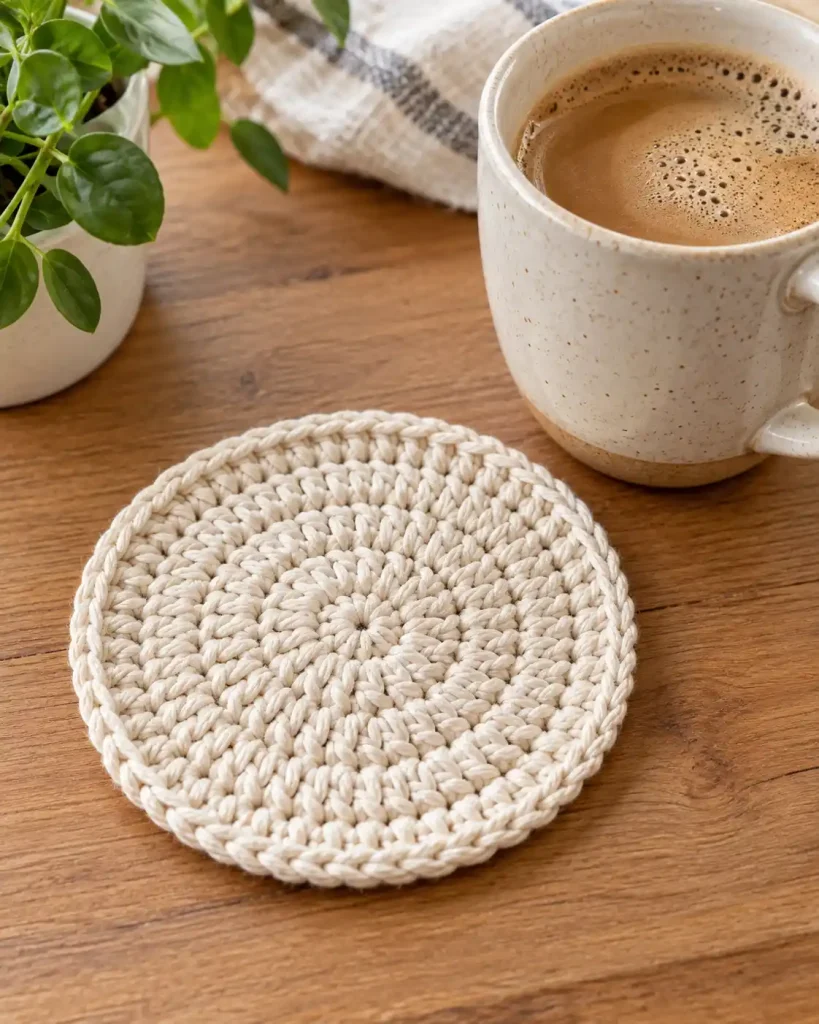
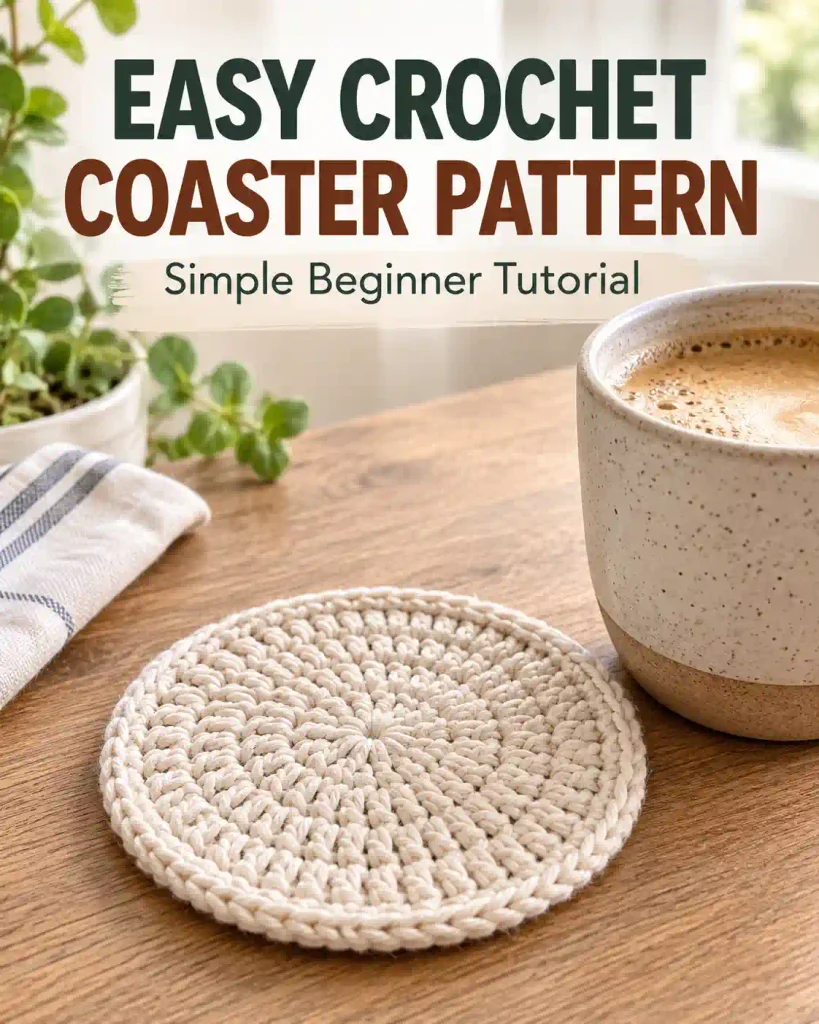
Easy Crochet Coaster Pattern is a beginner-friendly project for creating a practical round coaster with simple US crochet stitches. Worked from the center outward, the pattern uses evenly spaced half double crochet increases to keep the circle flat. You will learn how to crochet the center, increase each round correctly, add a neat single crochet border, and finish the coaster securely for everyday use.
Easy Crochet Coaster Pattern at a Glance
This Easy Crochet Coaster Pattern creates a simple round coaster worked entirely in one piece. The center-out construction eliminates seams and makes the stitch progression easy to follow.
- Skill level: Beginner
- Terminology: US crochet terms
- Yarn: Worsted weight cotton, category 4
- Hook: 4 mm crochet hook
- Construction: Center-out joined rounds
- Main stitch: Half double crochet
- Border: Single crochet
- Finished diameter: Approximately 4–4.5 in / 10–11.5 cm
- Estimated time: Approximately 25–40 minutes
- Gauge: Helpful but not critical for this project
- Total rounds: 5
The measurements and making time are approximate, not tested specifications. Yarn thickness, hook choice, and individual tension can change the finished size. The most important goal is to maintain a flat circular shape with accurate stitch counts.
Easy Crochet Coaster Pattern: Materials and Yarn Quantities
For this Easy Crochet Coaster Pattern, cotton yarn is recommended because it creates a firm surface with good stitch definition. Only a small quantity is required for one coaster.
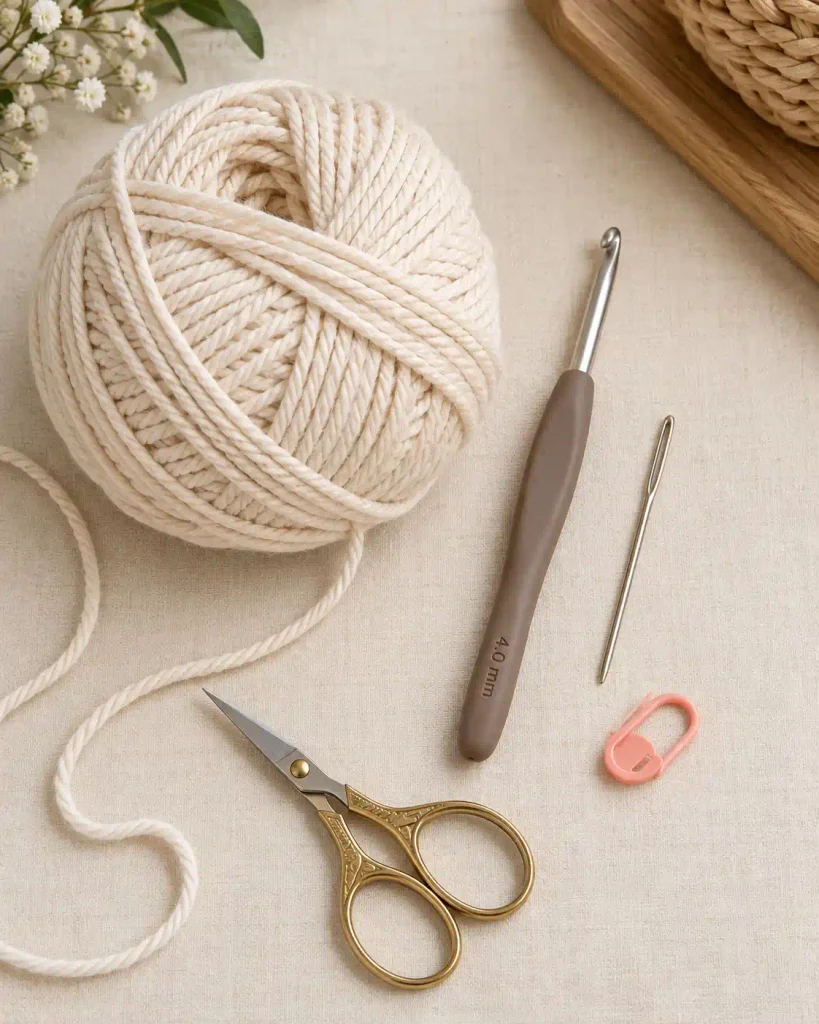
You will need:
- Worsted weight cotton yarn, category 4: approximately 20–30 yd / 18–27 m
- Approximate yarn weight: 10–15 g
- 4 mm crochet hook
- Yarn needle
- Scissors
- Stitch marker, optional
These yarn quantities are approximate because yardage can vary with yarn construction and personal tension.
A cotton blend can be substituted if it produces a stable fabric suitable for the coaster’s intended use. If you choose another fiber, consider its absorbency, heat tolerance, and care requirements.
You can also use a different yarn weight. Choose a hook appropriate for the replacement yarn rather than automatically using the 4 mm hook. Lighter yarn generally produces a smaller coaster, while thicker yarn creates a larger and heavier finished piece.
Easy Crochet Coaster Pattern: Abbreviations and Special Stitches
The Easy Crochet Coaster Pattern uses standard US crochet terminology.
- ch – chain
- st(s) – stitch(es)
- sl st – slip stitch
- sc – single crochet
- hdc – half double crochet
- MR – magic ring
- [ ] – repeat the instructions inside the brackets
An hdc increase means working 2 half double crochet stitches into the same stitch.
The ch 1 at the beginning of a round does not count as a stitch. Work the first actual stitch into the first stitch of the previous round.
Each round is closed with a slip stitch into its first actual stitch. Do not include the joining slip stitch when checking the final stitch count.
Easy Crochet Coaster Pattern Gauge, Size and Notes
The finished Easy Crochet Coaster Pattern should measure approximately 4–4.5 in / 10–11.5 cm in diameter when made with worsted weight cotton and a 4 mm hook.
Gauge is not critical because this is not a fitted item. As an approximate size reference, the coaster should measure around 3.5–4 in / 9–10 cm across after Round 4, before the final border.
These dimensions are estimates rather than tested gauge specifications.
The coaster is worked in joined rounds from the center outward. The beginning ch 1 and joining slip stitches do not count toward the stitch totals.
Check the circle on a flat surface as you work. If it cups despite having the correct stitch counts, your tension may be tight. If it develops pronounced ruffles, first check for accidental extra stitches before adjusting your hook or tension.
Easy Crochet Coaster Pattern: Method Overview
The Easy Crochet Coaster Pattern starts with 12 half double crochet stitches worked into a magic ring. The next three rounds expand the circle through evenly distributed increases.
Each increase round adds 12 stitches. The stitch progression is therefore 12, 24, 36, and 48 stitches. This predictable structure makes it easy to check your work after every round.
Once the circle reaches 48 stitches, stop increasing. The final round uses one single crochet in each stitch, maintaining the same 48-stitch count while creating a compact outer border.
No separate components need to be made or sewn together. After completing the border, fasten off and secure both yarn tails.
The full construction sequence is:
Magic ring → center → increase rounds → single crochet border → finishing
Count each round before moving forward because an incorrect increase can affect the final shape.
How to Crochet the Coaster Center
The center of the Easy Crochet Coaster Pattern establishes the circular structure. Use your worsted weight cotton yarn and 4 mm crochet hook.
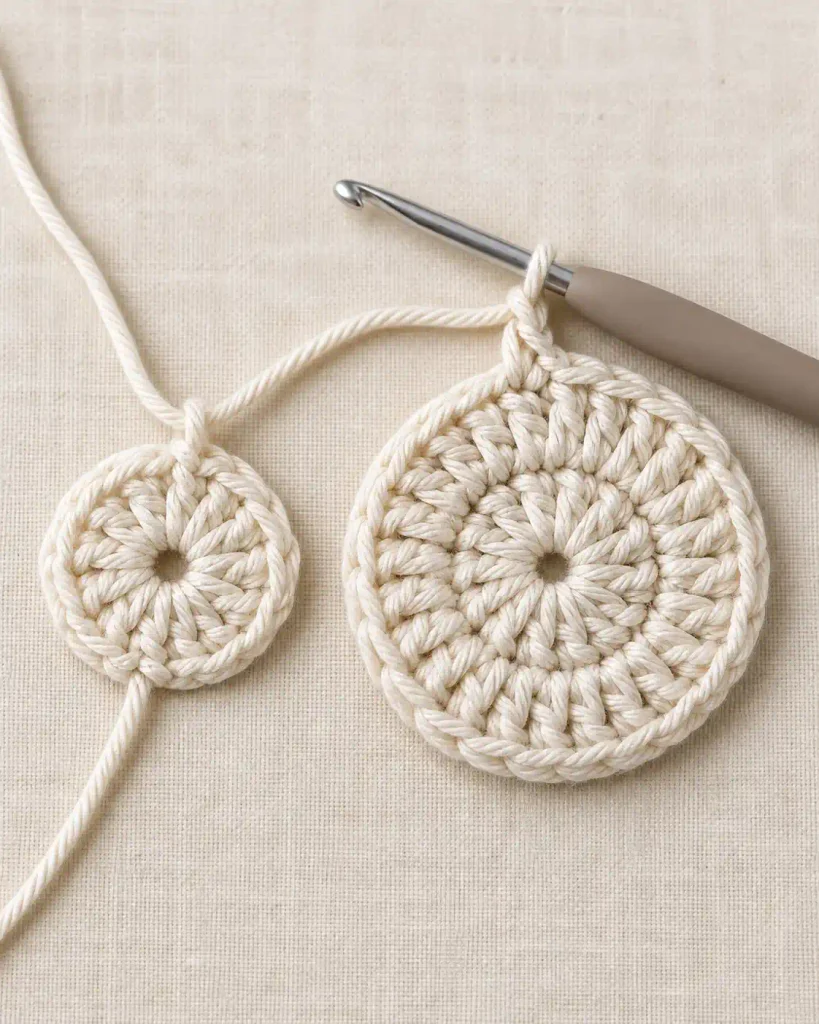
Round 1: Make a MR. Ch 1 and work 12 hdc into the ring. Pull the starting tail to close the center. Join with a sl st to the first hdc. (12 sts)
Count the stitches before continuing. There should be 12 actual half double crochet stitches.
Round 2: Ch 1. Work 2 hdc in each stitch around. Join with a sl st to the first hdc. (24 sts)
Round 2 doubles the original stitch count and begins expanding the center into a flat circle.
Place the work on a flat surface and gently smooth it with your fingers. A small amount of movement in the fabric is normal, but the center should not form a deep cup.
If the magic ring has loosened, pull the starting tail again to close the opening before proceeding to the next round.
How to Increase the Coaster Circle
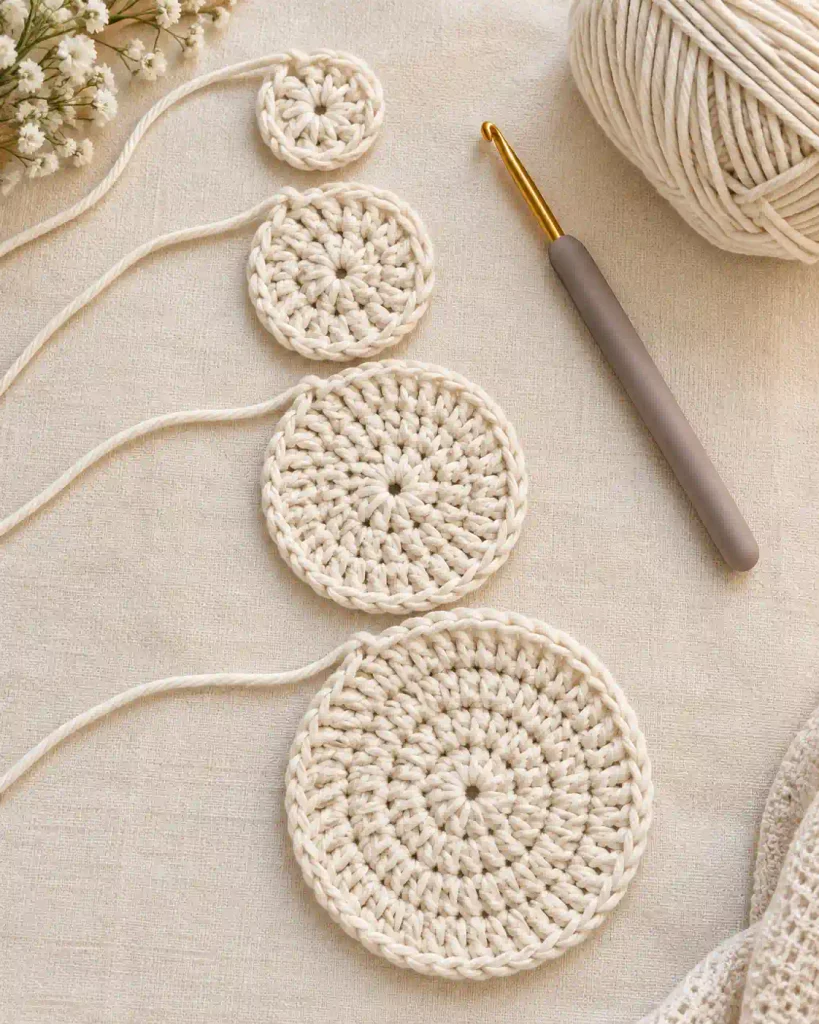
Continue the Easy Crochet Coaster Pattern by distributing the increases evenly. Accurate placement helps the coaster expand without creating unnecessary folds or waves.
Round 3: Ch 1. Repeat [1 hdc in the next st, 2 hdc in the next st] around. Join with a sl st to the first hdc. (36 sts)
Count all 36 stitches before starting the next round.
Round 4: Ch 1. Repeat [1 hdc in each of the next 2 sts, 2 hdc in the next st] around. Join with a sl st to the first hdc. (48 sts)
Your stitch progression should now be:
- Round 1: 12 hdc
- Round 2: 24 hdc
- Round 3: 36 hdc
- Round 4: 48 hdc
Place the circle on a flat surface again. It should measure approximately 3.5–4 in / 9–10 cm across, although your result may vary.
Do not add another increase round for this version. The coaster body is now complete, and the next round creates the border.
How to Crochet the Coaster Border
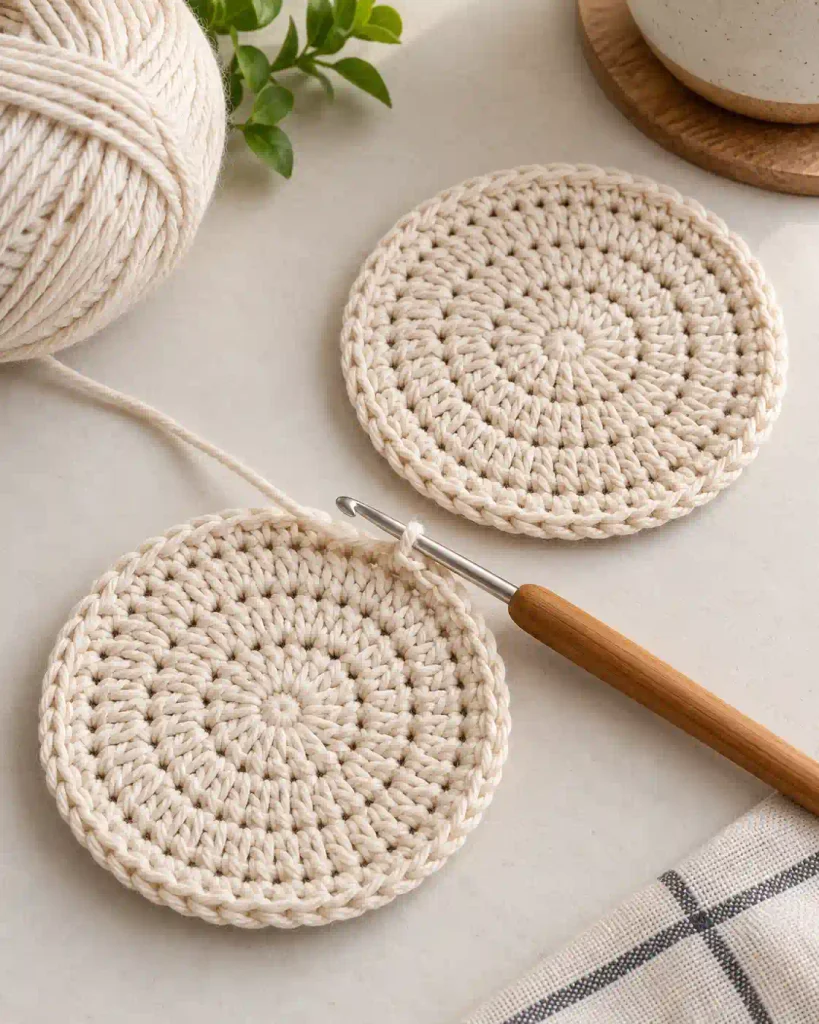
The border gives the Easy Crochet Coaster Pattern a clean outer edge without significantly increasing its diameter.
Unlike the previous rounds, there are no increases in this stage.
Round 5: Ch 1. Work 1 sc in each of the 48 stitches around. Join with a sl st to the first sc. (48 sts)
Count the border stitches before fastening off. You should still have exactly 48.
Single crochet is shorter and more compact than the half double crochet used in the body. This difference helps define the edge of the coaster.
If the border pulls strongly inward, check that you did not skip any stitches. If the stitch count is correct, try keeping your single crochet tension slightly more relaxed.
Cut the yarn, leaving approximately 5–6 in / 13–15 cm for weaving in. Pull the yarn tail through the final loop and tighten gently.
Smooth the border with your fingers before finishing the yarn ends.
Easy Crochet Coaster Pattern: Assembly
The Easy Crochet Coaster Pattern is made entirely in one piece, so there are no separate components to assemble. Instead, use this stage to secure the construction and inspect the completed circle.
Start at the center. Make sure the magic ring is completely closed. If a small opening remains, carefully tighten the starting tail without distorting the surrounding stitches.
Next, inspect the joins between rounds. Each joining slip stitch should hold the round securely without being counted as an additional stitch.
Run your fingers around the outer border and gently arrange it into an even circle. Check that the final round contains 48 single crochet stitches and that no section has been accidentally skipped or increased.
Finally, turn the coaster over and prepare both yarn tails for weaving in. There should be no seams or attached pieces because the complete coaster has been constructed from one continuous center-out circle.
Easy Crochet Coaster Pattern: Finishing and Care
To finish the Easy Crochet Coaster Pattern, thread each yarn tail onto a yarn needle. Weave the tails through several stitches on the reverse side, changing direction at least once before trimming the excess.
Place the coaster on a flat surface and check its shape. If minor unevenness remains, gentle blocking may help create a more regular circle. Avoid stretching the coaster larger than its natural dimensions.
Choose a blocking method suitable for the fiber you used.
Always follow the care instructions printed on the yarn label. Cotton, acrylic, blends, and other fibers may have different washing, drying, and heat recommendations.
Before using the coaster, check that the center is securely closed, the border lies evenly, and all yarn ends are firmly woven in. Allow a damp or blocked coaster to dry completely before use.
FAQs and Troubleshooting for Easy Crochet Coaster Pattern
1. Why don’t I have 48 stitches after Round 4?
Check each round rather than adding stitches at the end to compensate. The correct progression is 12, 24, 36, and 48 stitches. A missed increase in Round 2 or 3 will affect later counts. Also make sure you have not counted the beginning chain or joining slip stitch as an actual stitch.
2. Why is my Easy Crochet Coaster Pattern curling upward?
First verify every stitch count. If the counts are correct but the coaster forms a bowl, your tension may be tighter than expected. A slightly larger crochet hook can provide more room for the stitches and help the circle relax. Minor curling may also improve after appropriate blocking.
3. Can I substitute acrylic yarn for cotton?
You can use acrylic, but it behaves differently from cotton. Consider the coaster’s intended use before substituting fibers, particularly absorbency and heat tolerance. Always follow the manufacturer’s instructions for the yarn you choose. A cotton or suitable cotton blend is a practical option for this pattern.
4. How can I make the coaster bigger?
Using thicker yarn with an appropriate larger hook is the simplest way to increase the overall dimensions without changing the written stitch sequence. Adding more crochet rounds requires continuing the circular increase formula correctly. Simply adding several rounds without increases may cause the edge to cup instead of remaining flat.
5. Why does my coaster have a wavy outer edge?
Check for accidental increases first. Round 4 should contain 48 hdc, and the border should contain exactly 48 sc. If those counts are correct, loose tension can contribute to waviness. Minor unevenness may respond to gentle blocking, but significant ruffling should be corrected by checking the affected rounds rather than relying on blocking alone.
Final Thoughts
The Easy Crochet Coaster Pattern provides a simple way to practice magic rings, half double crochet stitches, circular increases, and clean edging in one useful project. Following the 12, 24, 36, and 48-stitch progression makes it easier to identify mistakes before they affect the finished shape. The single crochet border completes the coaster without introducing another increase round. Once you are comfortable with the construction, you can experiment with different cotton colors or suitable yarn weights while remembering that substitutions will affect the final dimensions. Keep your stitch counts accurate, secure the center carefully, and finish the yarn ends neatly for a clean result. Explore more beginner crochet patterns for your next project, or try this Medium Crochet Pumpkin Pattern to practice ribbed crochet, stuffing, and shaping for a seasonal project.