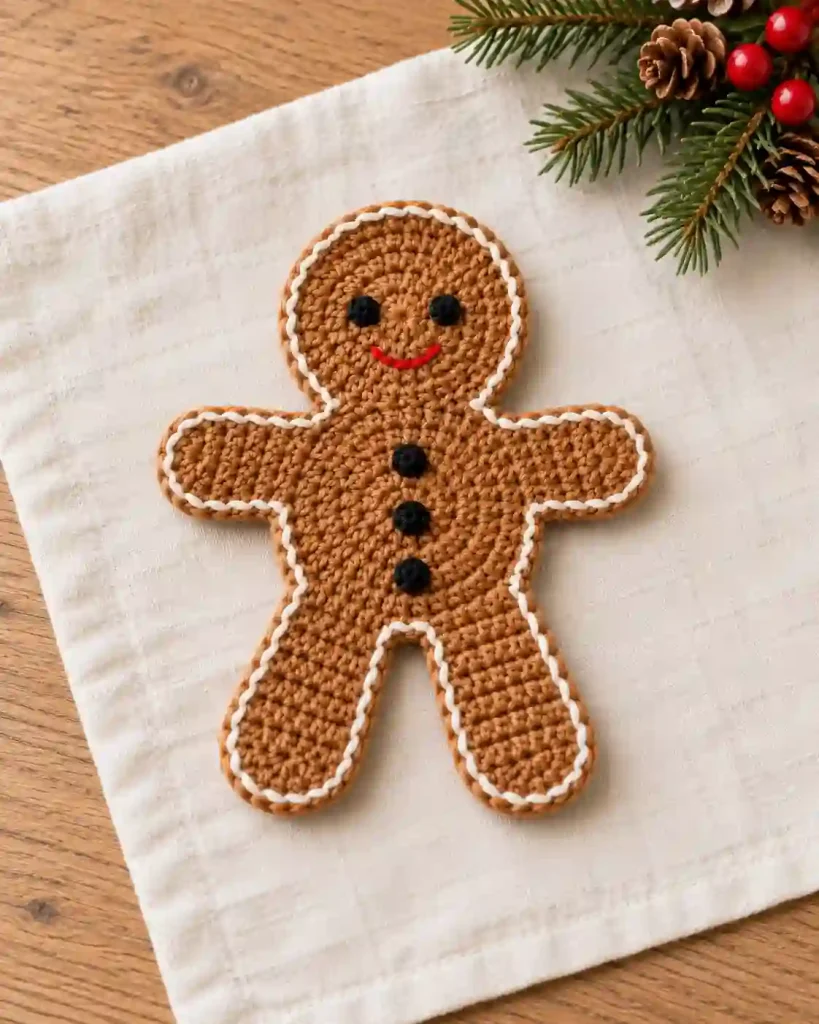
Crochet Gingerbread Man Pattern projects bring a handmade touch to Christmas decorating, with warm brown yarn, white edging, and a cheerful embroidered smile. This guide explains how to create a flat, double-layer gingerbread figure, from the circular head and body to the arms, legs, and final seam. It follows the construction of Repeat Crafter Me’s original crochet gingerbread man pattern, with additional stitch-count explanations and finishing guidance.
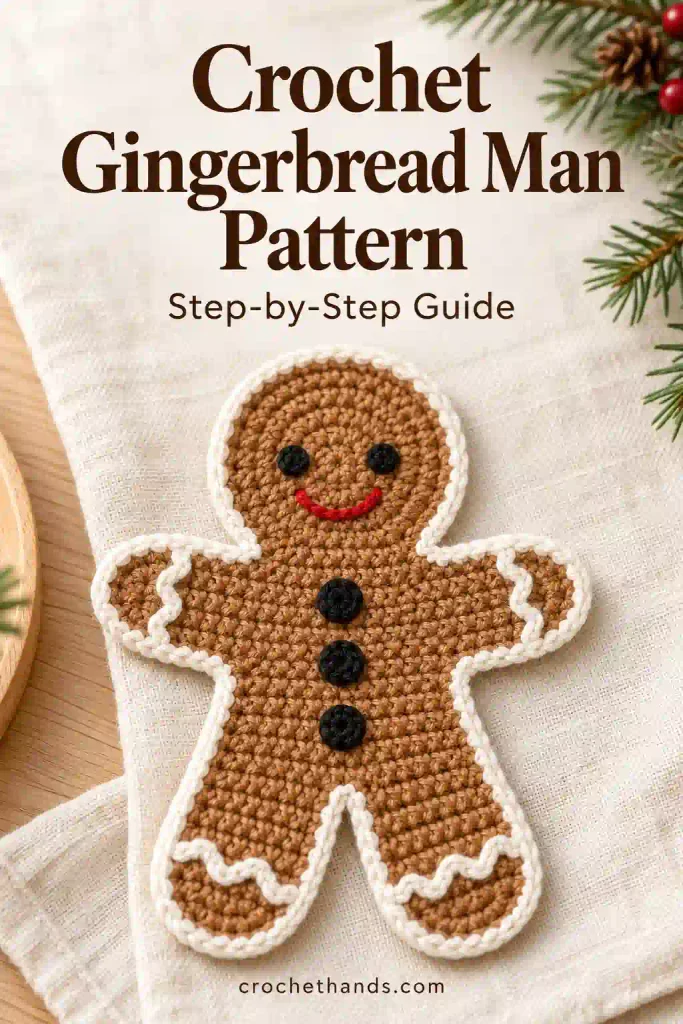
Crochet Gingerbread Man Pattern at a Glance
This project suits confident beginners who can work into a magic ring, crochet joined rounds, and sew small pieces together. The main shaping uses double crochet and treble crochet, followed by a single crochet border.
You will make two matching gingerbread silhouettes. Each silhouette consists of a separate circular head attached to a body with four chain-based limbs. Decorating the front before joining the layers keeps the back of the embroidery hidden.
The original designer reports a finished size of approximately 6 inches tall by 4½ inches wide, or 15.2 × 11.4 cm. Your result will depend on yarn, hook, and tension.
The figure is intended here as an unstuffed decoration. Gauge is less important than producing two matching layers with tidy edges. No verified making time is supplied; allow extra time for attaching the heads, embroidering the face, and matching the border stitches.
Crochet Gingerbread Man Pattern: Materials and yarn quantities
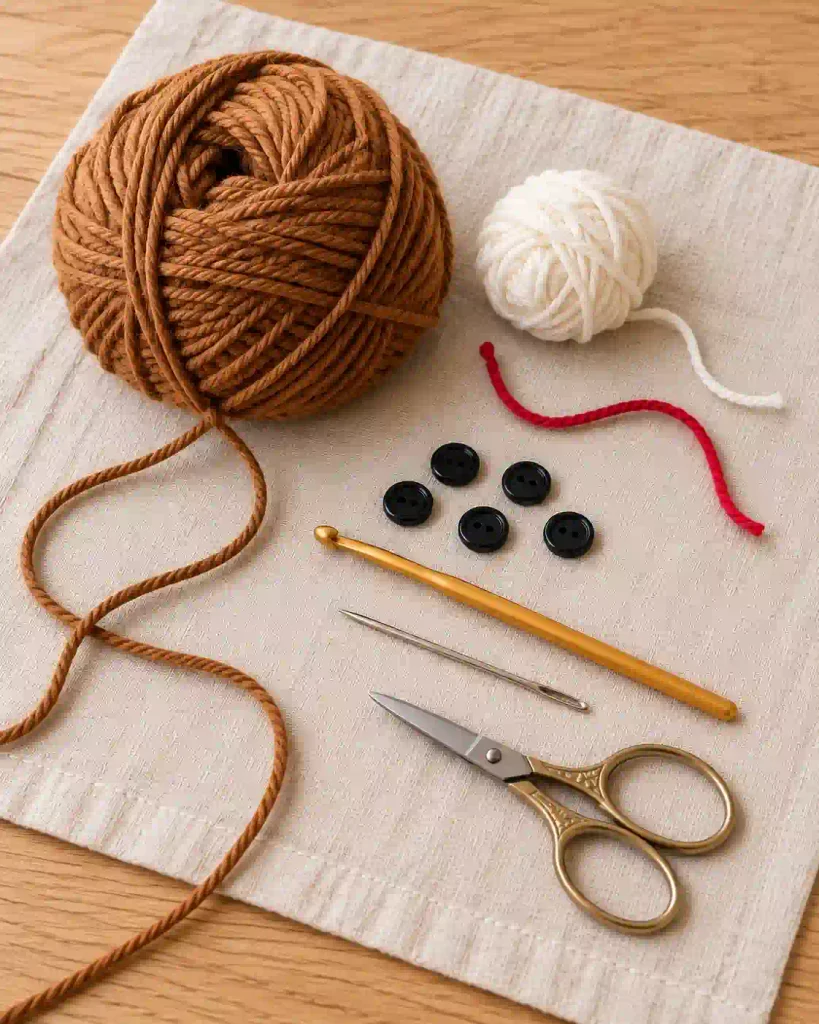
Gather the following supplies:
- Brown yarn: Bernat Super Value in Topaz, or a comparable medium-weight, category 4 yarn.
- White yarn: A small amount for the contrasting seam.
- Red yarn: A short length for the mouth.
- Black yarn: Optional, for embroidered eyes and buttons.
- Hook: US H/8, 5 mm.
- Tapestry needle: For attaching the heads, embroidering, and securing ends.
- Scissors.
- Stitch markers: Helpful for identifying attachment points.
- Optional embellishments: Two small safety eyes and three slightly larger safety eyes used as buttons, following the source design.
The source does not provide yarn consumption. As an untested planning allowance, set aside approximately 40–60 yards of brown yarn, 10–15 yards of white, and a few yards of embroidery colors. These are purchasing allowances, not measured requirements.
Choose substitute yarns with similar thickness. Using the same yarn range for both brown layers helps them match. Embroidered details offer a softer alternative to plastic hardware and avoid bulky washers between the layers.
Crochet Gingerbread Man Pattern: Abbreviations and special stitches
All terminology below uses US crochet terms:
- ch: Chain.
- sl st: Slip stitch.
- sc: Single crochet.
- dc: Double crochet.
- tr: Treble crochet, sometimes called triple crochet.
- st/sts: Stitch/stitches.
For a magic ring, form an adjustable yarn loop, work the stated stitches into it, and pull the tail to close the center. Secure that tail carefully during finishing.
To make tr, yarn over twice, insert the hook, yarn over and draw up a loop, then yarn over and pull through two loops three times.
For the count convention used in this guide, beginning ch-2 does not count as a stitch. Join circular rounds to the first actual dc. When working along a limb chain, begin in the fourth chain from the hook.
Crochet Gingerbread Man Pattern Gauge, Size and Notes
A precise gauge swatch is unnecessary for this decoration. Instead, compare the two heads and the two body circles before continuing. Matching components matter more than matching a particular stitch density.
The approximately 6 × 4½-inch measurement comes from the original design; it is not a guaranteed result for every substitute yarn.
Work the initial circles in joined rounds without turning. Under this guide’s counting convention, each circle begins with 10 dc, followed by 20 dc in the second round. Do not work an extra stitch into the joining slip stitch.
The arms and legs extend from the body circle using chains and return stitches. The outer sc border follows the complete silhouette after the head is attached.
No fixed total is supplied for that border. Chain edges, limb tips, and neck joins require careful placement, so repeat the same choices on both layers.
Crochet Gingerbread Man Pattern: Method overview
Begin with the two heads, then make the two body circles. Working matching components together makes differences in tension easier to notice.
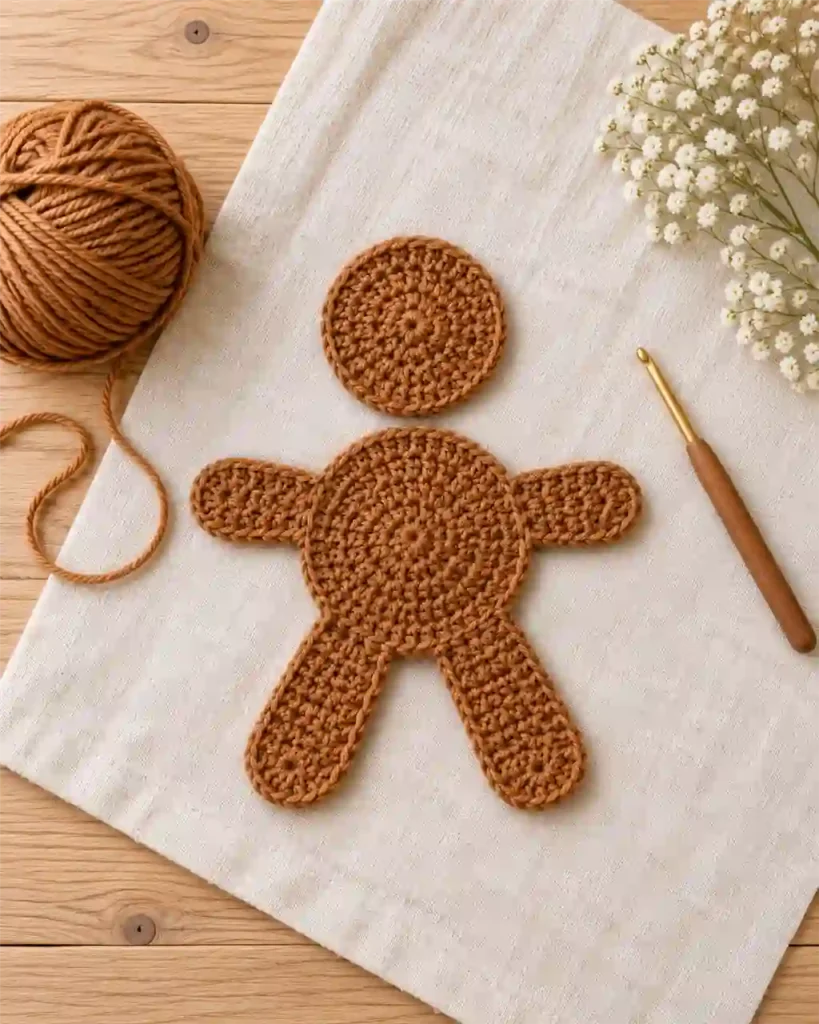
Each body receives its limbs in this order: one arm, one leg, the second leg, and the second arm. The remaining upper section provides the attachment area for the head.
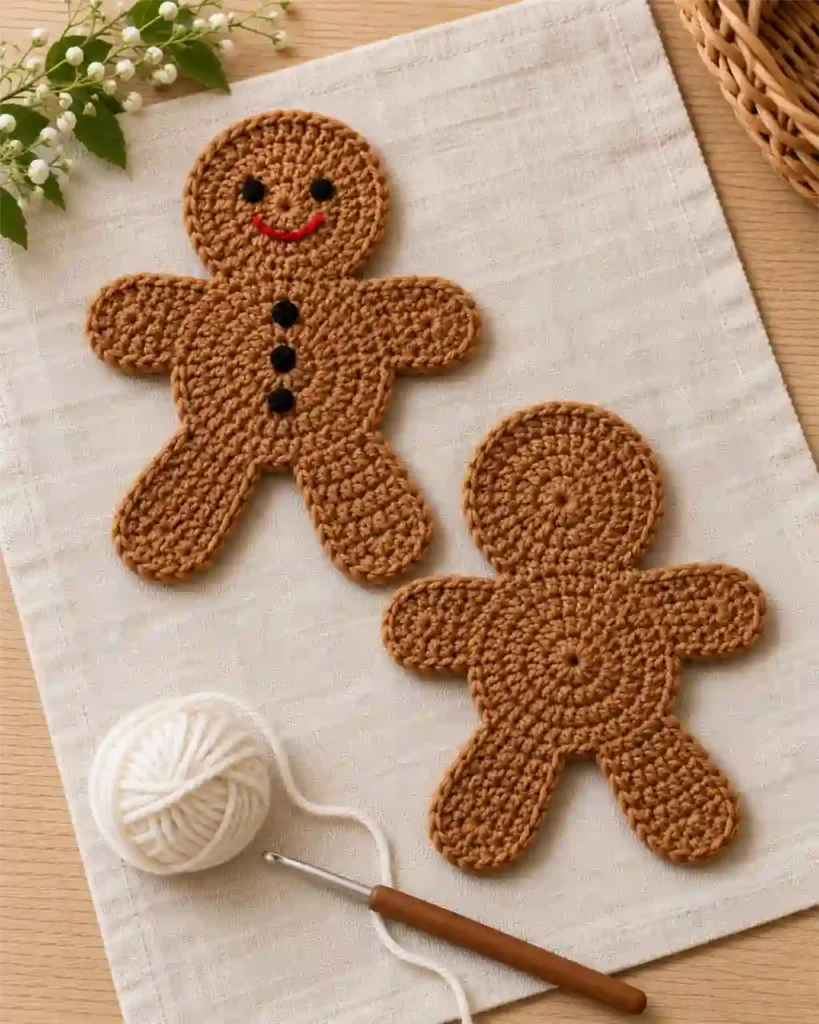
Sew a head onto each body, then crochet a brown border around each complete figure. Lay the silhouettes together before decorating; their heads, hands, and feet should align comfortably.
Embroider the mouth and position the eyes and buttons on the front piece. Leave the second piece plain.
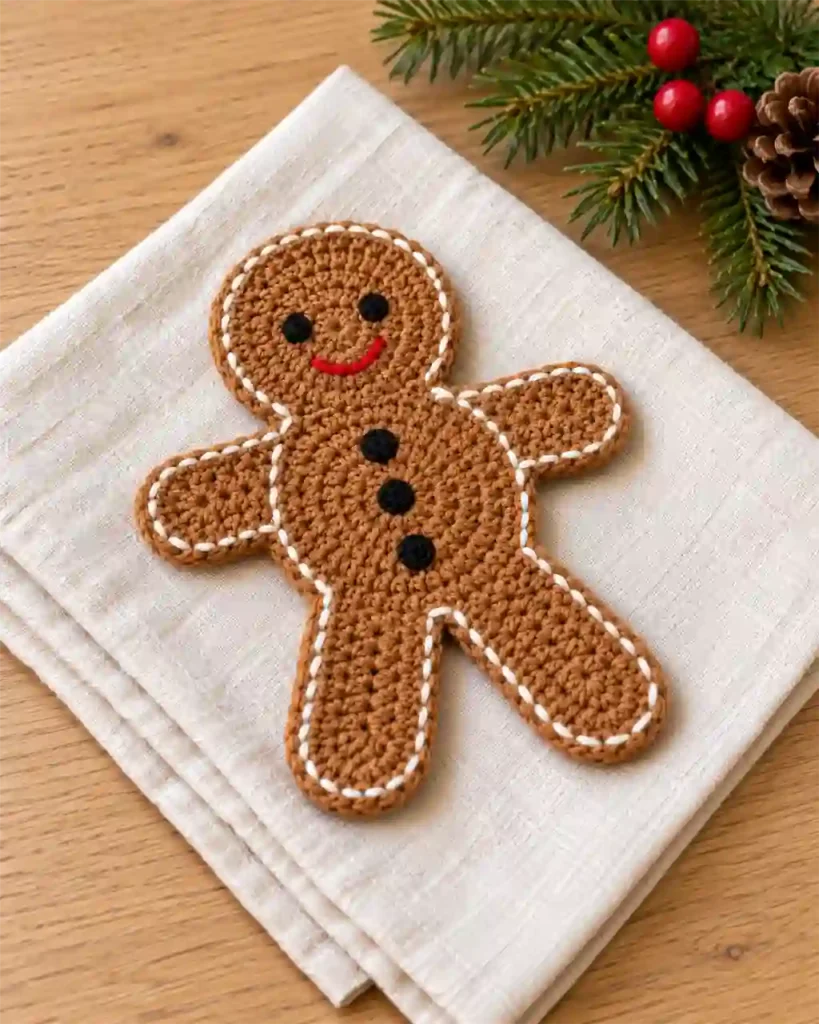
Finally, place the pieces with their wrong sides facing and join their edges with white slip stitches. This creates the icing-like outline and encloses the embroidery backs.
For a coordinated display, pair your finished figures with the crochet Christmas garland pattern.
Crochet Gingerbread Man Pattern: Step-by-Step Tutorial
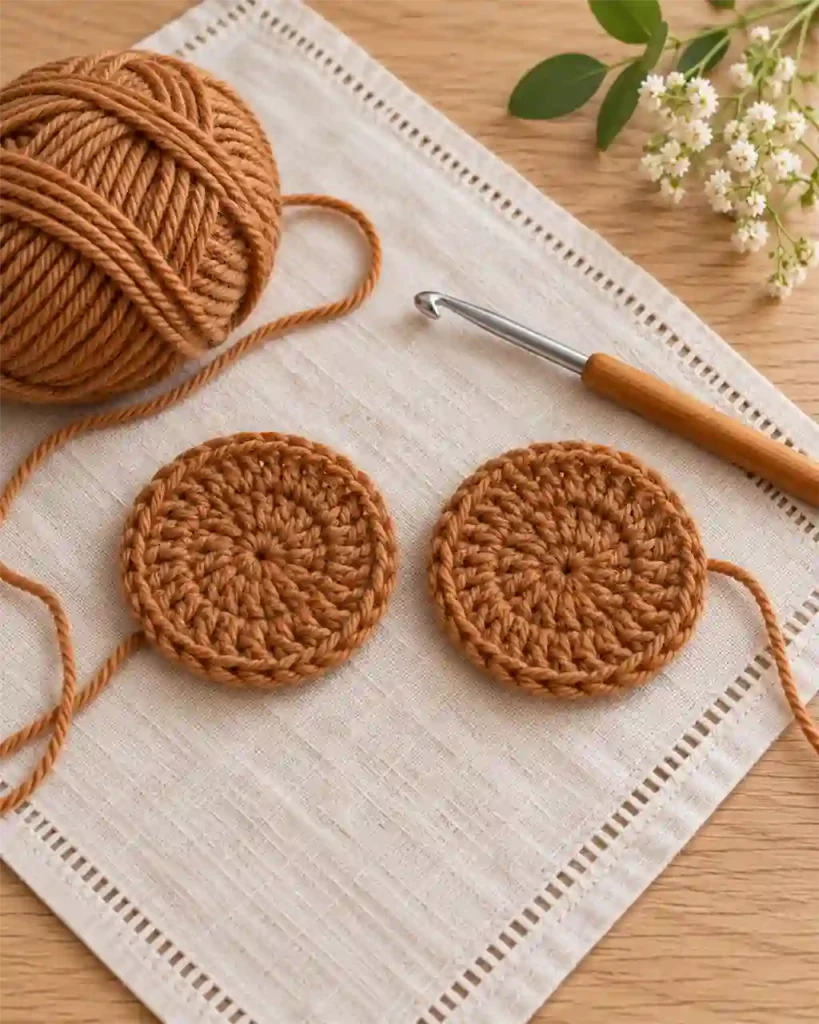
Make Two Circular Heads
Use brown yarn and leave enough tail for secure finishing.
- Make a magic ring.
- Ch 2, then work 10 dc into the ring.
- Pull the ring closed and join with a sl st to the first dc. Count: 10 dc.
- Ch 2.
- Work 2 dc into each of the 10 stitches.
- Join with a sl st to the first dc. Count: 20 dc.
- Fasten off, leaving a long tail for attaching the head.
Repeat for the second head.
Place the circles together and compare their diameter and tension. A slight curve can be assessed again after assembly, but a substantial difference between heads is worth correcting now.
Count only the actual double crochet stitches. Including the starting chain or joining stitch can change the second round and make the head larger than intended.
Thread each center tail through the stitches on the wrong side to secure the magic ring. Keep the longer outer tail available for the neck seam.
Make the Body Circles and Four Limbs
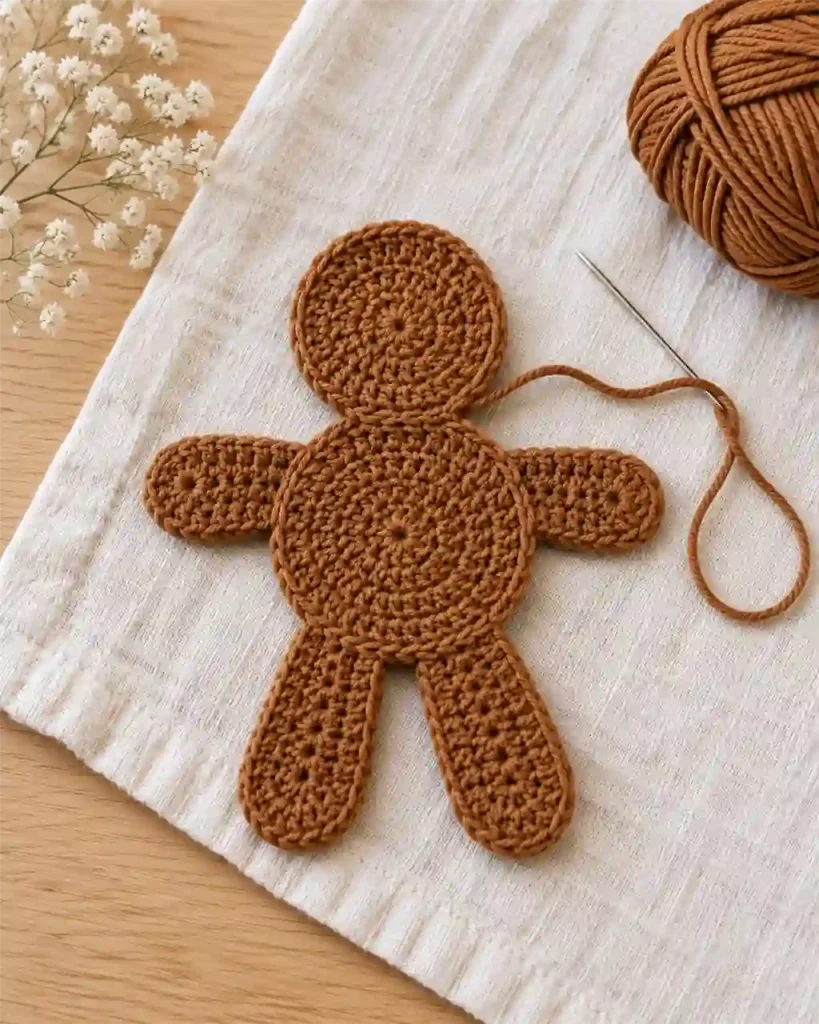
Make a brown body circle using the same first two rounds as the head: 10 dc in Round 1 and 20 dc in Round 2. Join to the first dc.
Shape the limbs from that joining position:
- First arm: Ch 7. Work tr in the fourth chain from the hook and in each remaining chain: 4 tr. On the body circle, skip the next 3 sts and sl st into the following st.
- First leg: Ch 10. Work tr in the fourth chain from the hook and in each remaining chain: 7 tr. Skip the next 3 body sts and sl st into the following st.
- Second leg: Repeat the first leg: 7 tr, skip 3 body sts, then sl st into the following st.
- Second arm: Repeat the first arm: 4 tr, skip 3 body sts, then sl st into the following st.
Each attachment advances four stitches around the body. After four limbs, 4 body stitches remain unworked between the last attachment and the starting position.
Keep the working loop secure without fastening off. Make the second body using identical counts.
Attach the Heads and Border Both Silhouettes
Position a head above the unworked upper section of the first body. Check that the two shorter limbs sit at the sides and the longer limbs point downward.
Use the head’s long tail to sew a short section of its lower edge to the upper body. The source does not specify an exact head-seam stitch count. Center the head, make a secure seam, and repeat the same placement on the second figure.
Return the hook to the saved body loop.
Work sc around the entire exposed outline, including the head. Place stitches into the available stitch tops and distribute them evenly along chain edges and stitch sides.
At each hand and foot tip, work at least 3 sc, as directed in the source, to help the border turn. Check the result as you go: a tight edge pulls inward, while too many stitches can produce ripples.
Fasten off after completing the outline. Compare both silhouettes and correct mismatched border sections before joining them.
Crochet Gingerbread Man Pattern: Assembly
Choose the neater silhouette for the front. Arrange the eyes on the head and three buttons down the body before attaching anything permanently.
Embroider a red smile with small stitches. Secure the ends on the wrong side without pulling tightly enough to pucker the face. If using plastic safety eyes, attach their washers before closing the layers. Safety eyes are small components; choose embroidered features for decorations intended for young children.
Place the two silhouettes together with wrong sides facing. Match the head, neck, hands, and feet, using markers to hold these points.
Join white yarn at a discreet position. Slip stitch through corresponding brown border stitches on both layers, following the source’s joining method.
Keep the white stitches relaxed. A tight seam can shorten the limbs and curl the edges.
Continue around the complete figure, join neatly, fasten off, and secure the white ends inside the seam.
Crochet Gingerbread Man Pattern: Finishing and care
Lay the gingerbread figure flat and gently adjust the arms and legs. Check the neck seams, closed magic rings, embroidery ends, and white edging.
If shaping is needed, follow the yarn label’s blocking guidance. Acrylic yarn can be damaged by direct heat, so avoid pressing it with a hot iron. Gentle damp shaping may be sufficient.
Care depends on both the yarn and the embellishments. Follow the yarn label, and choose gentle spot cleaning when attached components make machine washing unsuitable. Let the figure dry flat and completely before storing it.
Store decorations without crushing their limbs. If you are making a mixed ornament collection, the easy crochet Christmas bauble pattern provides another seasonal project to display alongside the gingerbread figures.
FAQs and Troubleshooting for Crochet Gingerbread Man Pattern
1. Why does my second circle round have more than 20 stitches?
The usual cause is counting the beginning ch-2 as a stitch or crocheting into the joining slip stitch. This guide uses 10 actual dc in the first round and two dc in each of those stitches in the second. Mark the first dc and recount before shaping the limbs.
2. Why are my circles cupping or my limbs curling?
Check the stitch counts first. Tight tension can restrict the circles, and a tight outer border can pull the limbs inward. Compare both layers before assembly. If counts are correct but the fabric remains strongly distorted, try a slightly larger hook on a replacement component.
3. Can I substitute cotton for acrylic?
Yes, provided you are comfortable with a different texture and potentially different dimensions. Cotton may produce a firmer, heavier decoration. Use matching yarn for both silhouettes, choose a hook that gives comfortable fabric, and follow the substitute yarn’s care instructions.
4. How can I make a smaller or larger gingerbread man?
The simplest approach is to change yarn thickness and use a suitable hook while keeping the construction counts. Finer yarn generally creates a smaller figure; thicker yarn generally creates a larger one. Exact dimensions remain unverified. Changing only limb-chain lengths also changes the proportions.
5. Can I wash the finished decoration?
Check the yarn label and consider every attached component. Plastic eyes, buttons, embroidery, and hanging attachments may need gentler treatment than the yarn alone. Spot clean when uncertain, avoid twisting the figure, and dry it flat. Check that it is fully dry before packing it away.
Final Thoughts
A carefully matched pair of silhouettes, a relaxed white seam, and a simple smile give this gingerbread decoration its character. Take time to compare the pieces before joining them; small adjustments are easier while the backs remain accessible. Credit Repeat Crafter Me when sharing work based on the linked design, and use your own finished-project photographs. After your holiday decorations are complete, explore the iPhone 18 Pro Max crochet case pattern for a different kind of crochet project.